Alexia Duchêne’s Le Chêne Brings Old-School French Luxury to New York
Alexia Duchêne is making a case for French dining with a little ceremony. At Le Chêne, the New York restaurant she opened with her husband, Ronan Duchêne Le May, the pitch is direct: pithiviers, côte de boeuf, and crisp white linens. The appeal is old-school luxury, served without apology.
There is a useful distinction between luxury as a price tag and luxury as an experience. A high bill can buy rare ingredients, elaborate service, and an impressive room; it can also buy little more than expensive wallpaper and a menu that mistakes excess for pleasure. Le Chêne’s stated idea is more legible: it reaches for a recognizable French restaurant language, where a pithivier arrives as a centrepiece and a côte de boeuf suggests a meal built for sharing. That does not prove the execution is excellent. It does explain why the proposition has caught attention.
The context matters. Duchêne had already built a profile in Paris, then made a transatlantic move that she partly connected to the hard economics of running a restaurant in Europe. Her career is therefore more than a television-chef story. It is also a practical case study in ambition, business pressure, and the appeal of bringing a distinct culinary point of view to a city that has room for both novelty and tradition. Here is what is known, what remains unreported, and how to judge the restaurant on its own terms.
What Is Le Chêne, and What Makes Its Style Distinctive?
Le Chêne is a French restaurant in New York’s West Village, opened by chef Alexia Duchêne and her husband, Ronan Duchêne Le May. The restaurant is described as luxe and indulgent, with an old-school French sensibility: pithiviers and côte de boeuf are among the named dishes, and tables are dressed in crisp white linen. Those details point to a dining room that wants the meal to feel like an occasion, not a hurried stop between errands.
Duchêne’s path to the restaurant gives the concept useful context. In 2019, she reached the semifinals of the French television competition Top Chef France. She later earned praise in Paris for Datsha Underground, before moving to the United States. The New York Times reported that she connected the move partly to the challenge of making a restaurant profitable in Europe. That motivation is worth taking seriously: a chef’s choices are shaped not only by taste and ambition, but by rent, labor, investment, and the possibility of keeping a business alive. The Times coverage can be located through its search archive for Alexia Duchêne and Le Chêne.
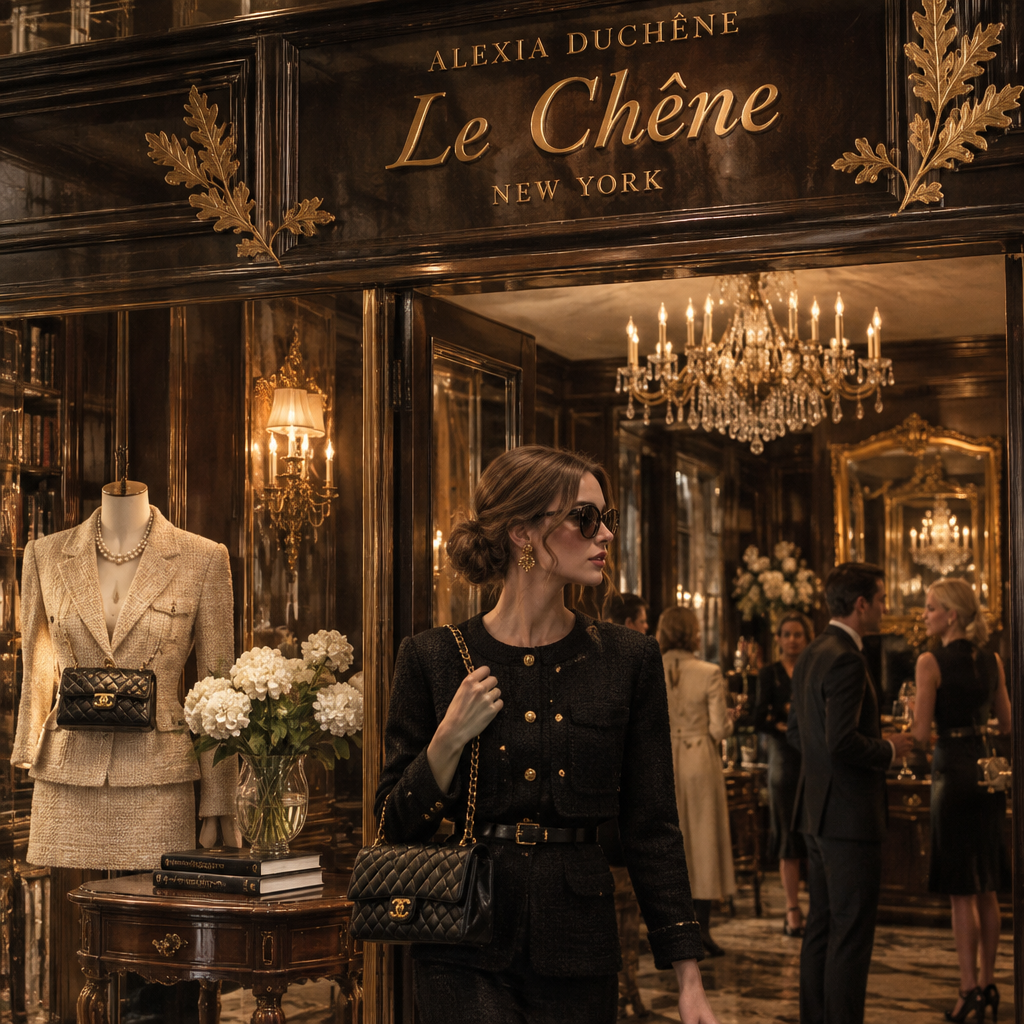
The name itself signals French identity, but a name is not proof of quality. Nor does a chef’s television profile tell a diner whether the room is comfortable, the cooking consistent, or the bill fair. What the known details do offer is a clear point of view: this is not being presented as minimalist dining, a casual café, or a menu built around surprise for its own sake. It leans toward the pleasures of classic French restaurant dining, where richness, presentation, and shared dishes all have a role.
That style can be meaningful when the cooking earns it. Pithivier, a filled pastry traditionally finished with a decorative top, asks for attention to pastry, filling, seasoning, and texture. Côte de boeuf makes the quality of the beef and the handling of the fire hard to hide. The exact recipes and preparations at Le Chêne are not reported here, so no sensible account should pretend to describe them. Still, the named dishes clarify the restaurant’s ambition: recognizable forms, substantial ingredients, and a little theatre at the table.
I assess a restaurant’s promise by asking what its format asks the kitchen to do. Here, the answer appears to be careful execution of classic, generous dishes rather than a parade of unexplained techniques. That can be a strong choice. It can also expose weak cooking quickly. A white tablecloth cannot rescue dry pastry or an overcooked roast, and a grand-sounding menu has to taste as convincing as it reads.
The wider French dining tradition values craft and the hands that perform it. Beauty can point beyond its price, while good stewardship asks whether spending supports real skill, sound ingredients, and dignified work. That is a better standard than buying a familiar luxury label and hoping the room supplies the substance.
Why the Le Chêne Proposition Matters
The strongest case for Le Chêne is not simply that it is expensive or French. It is that its identity seems easy to understand. In a city where restaurants compete for attention with new formats, a clear promise can help diners decide whether an evening suits them. Old-school French dining makes a particular offer: abundance, recognizable dishes, and an atmosphere that treats dinner as an event. The promise is appealing; the kitchen still has to keep it.
- A coherent culinary point of view. Pithivier and côte de boeuf are not generic shorthand for every kind of French cooking, but they suggest a preference for dishes with weight and presence. That is more persuasive than a menu that lists fashionable ingredients without explaining what the restaurant wants to be. A clear style also makes it easier for a guest to judge whether the meal delivered what was promised.
- A meal designed for company. A large roast or a pastry made to be shared can turn dinner into a social occasion. The effect depends on portion sizes and service, neither of which is specified in the reported details, so diners should check the current menu rather than assume. Even so, shared dishes give a restaurant a practical way to make a meal feel generous without relying on gimmicks.
- A visible respect for presentation. Crisp white linens are a small detail, but they show that the room is making a choice about how dinner should feel. Formal table dressing can create a sense of care when it is matched by attentive service and a comfortable room. If it is merely decoration, it is just cloth. Frankly, details matter only when they support the whole experience.
- A chef with experience in two markets. Duchêne’s earlier Paris work and move to New York give her story a transatlantic dimension. The economics she described to The New York Times are not glamorous, but they are relevant. Restaurant owners must make the numbers work as well as the food, and a new city can offer opportunity while bringing its own costs and competition. The reason for her move is reported; the full financial terms of either restaurant are not.
- A counterweight to novelty for novelty’s sake. Not every diner wants an elaborate tasting menu or a meal built around surprise. Traditional dishes can be satisfying precisely because they are legible. But tradition earns respect through sound technique, good ingredients, and judgment, not by being old. Nostalgia is no substitute for seasoning.
There are limits to what can be concluded from a restaurant’s concept. No current prices, complete menu, reservation policy, or detailed service description are established in the facts reported here. So the best case for Le Chêne is a case for its idea, not a blanket claim that every diner will find it worth the bill. A luxury restaurant earns its place when the room, cooking, hospitality, and price make sense together. If one part is weak, the linen is not going to save the evening.
How to Decide Whether Le Chêne Suits Your Dinner
A useful selection process starts with the occasion, not the reputation. I find that diners make better choices when they decide what they actually want from a meal—quiet conversation, a celebratory roast, a tasting menu, or a quick dinner—before they compare restaurant names. That sounds obvious. People routinely ignore it and then blame the restaurant for offering exactly the sort of evening it advertised.
- Set the purpose of the meal. Is this a birthday, a date, a business dinner, or a meal with friends who enjoy sharing? Le Chêne’s described emphasis on indulgent French dishes and white-linen tables suggests an occasion-oriented mood. Treat that as a clue, not a guarantee about noise, pacing, or formality; those details are not reported here.
- Check the current menu and prices. Menus change, and an older description does not establish what is being served today. Look for the dishes that matter to you, check whether the named classics remain available, and note any supplements or set-menu rules. If the restaurant does not publish a current price list, ask before booking. There is no virtue in discovering the cost only after everyone has ordered.
- Look for the preparation, not just the dish name. A pithivier can be compelling, but the label alone does not say what is inside, how it is seasoned, or whether it is intended for one person or several. The same goes for côte de boeuf: ask about size, accompaniments, and sharing if the menu is unclear. A good restaurant should be able to explain its food without turning a simple question into a performance.
- Match the format to the people at the table. Large or rich dishes suit some groups and not others. Consider appetite, dietary needs, and whether anyone prefers lighter food. The specific accommodations at Le Chêne are not established here, so contact the restaurant directly rather than assuming a dish can be adjusted. This is practical, not fussy.
- Judge value across the whole evening. Price is only one part of value. Consider the cooking, portion, atmosphere, service, and whether the meal gives you the kind of occasion you wanted. I would not call a restaurant good value merely because it uses luxurious ingredients, and I would not dismiss one simply because it costs more than a casual meal. The question is what the money buys, and whether that is worth it to you.
- Read current, specific reviews carefully. Look for recent comments that describe the food, service, and bill, rather than broad claims that the restaurant is either wonderful or terrible. One diner’s preference for formal service is another diner’s complaint about stiffness. Give extra weight to recurring, concrete observations. A single photograph of a glossy table proves very little about dinner.
- Confirm the practical details. Check opening hours, location, booking terms, cancellation rules, and any restrictions before you go. The exact opening date and current operating details are not provided in the reporting summarized here, and they should not be guessed from an older profile. For background on the chef’s competition history, see the official M6 Top Chef page; for up-to-date restaurant information, use the restaurant’s own current channels.
This process is not glamorous. It works. Good dining decisions are usually made with a menu, a budget, and a little honest thought—not by trusting the word luxury to do all the thinking.
Comparison Table: Le Chêne’s Stated Style vs. a Contemporary Tasting-Menu Format
There is no single restaurant that can fairly be called Le Chêne’s biggest competitor on the facts available. The useful comparison is therefore between the restaurant’s stated old-school French approach and a common alternative in premium dining: a contemporary tasting-menu format. The second column describes a broad format, not a claim about a particular New York restaurant. It is a comparison of approaches, not a scorecard.
| Feature | Le Chêne’s stated approach | Contemporary tasting-menu format |
|---|
| Known food cues | Pithivier and côte de boeuf are named in the available description. | Often organized as a sequence of courses; the specific ingredients vary by restaurant. |
| Meal structure | The exact menu structure is not reported. The named dishes suggest substantial, familiar French forms. | Usually course-led, with the kitchen determining the progression. |
| Table setting | Crisp white linens are part of the described presentation. | Room and table style vary; no single look defines the format. |
| Guest choice | Current menu choices and sharing rules are not reported; verify before booking. | Choice may be limited or guided by the set menu, though policies differ. |
| Best suited to | Diners drawn to classic French dishes and an occasion-oriented setting. | Diners who enjoy a planned sequence and the kitchen’s changing interpretation. |
| Main question for value | Do the cooking, service, room, and price justify the indulgent proposition? | Does the sequence, technique, and overall pacing justify the set price? |
The comparison clarifies a point often blurred by luxury marketing. A set menu is not automatically more sophisticated, and a familiar dish is not automatically more satisfying. The formats ask for different kinds of attention. One may give guests more freedom to choose; another may put more control in the chef’s hands. Which is better depends on the diner and the execution, not on a hierarchy invented by a brochure.

For Le Chêne, the fair test is specific: does the restaurant make its French classics feel carefully cooked and generous rather than merely expensive? Are the portions, service, and atmosphere coherent with the price? Those details are more useful than comparing it to an unnamed rival by reputation alone. If you prefer an unfolding sequence of small courses, a tasting-menu restaurant may suit you better. If you want a recognizable central dish and a more traditional sense of occasion, Le Chêne’s stated style may be closer to your taste.
Common Mistakes to Avoid
Mistake one: treating price as proof of quality. A premium bill tells you what the restaurant charges, not what it has earned. Luxury may include skilled labor, costly ingredients, and a thoughtful room, but it can also include a large markup with little extra pleasure. Ask what the meal delivers. If the answer is only that it looks expensive, the case is thin.
Mistake two: assuming classic means flawless. Old-school French cooking has a strong reputation, and sometimes that reputation is used as a shield. A pithivier still needs a well-made pastry and a balanced filling. A côte de boeuf still needs good handling and appropriate cooking. Tradition is a discipline, not a free pass. If a restaurant leans on classic dishes, execution should be especially convincing because diners know what those dishes are supposed to do.
Mistake three: believing a television competition guarantees a restaurant experience. Reaching the semifinals of Top Chef France in 2019 is a notable part of Duchêne’s career. It is not a substitute for checking the menu, the price, or recent reports from diners. Television can show talent under competition conditions; running a restaurant involves a different collection of demands, including staffing, consistency, purchasing, and the unglamorous daily work of keeping a business open.
Mistake four: assuming the restaurant is a direct continuation of Datsha Underground. Duchêne’s Paris restaurant and Le Chêne belong to different places and moments in her career. The available details do not establish that the two restaurants share a menu, service style, or business model. Do not assume that a Paris review describes what you will experience in New York. Names and careers travel; recipes, teams, and operating conditions do not automatically travel with them.
Mistake five: treating a move as a simple success story. Duchêne has discussed the difficulty of turning a profit in Europe, and that candor is more useful than a polished tale of effortless ambition. A move across countries can open possibilities, but the financial realities of a new restaurant remain real. The restaurant’s complete costs, revenues, and ownership arrangements are not reported. Anyone claiming certainty about its business performance is guessing.
Mistake six: booking for the photograph. White linens and a dramatic dish can look excellent online. They cannot tell you whether the room suits your group, whether the current menu fits your appetite, or whether the check works for your budget. Use images to understand atmosphere, not to outsource judgment. Here’s the kicker: a beautiful table is part of hospitality, but it is not the meal.
Mistake seven: confusing a strong concept with a guaranteed personal fit. A restaurant may execute its idea well and still not be the right choice for you. Someone who wants a quiet, inexpensive dinner may not want an indulgent, occasion-led French restaurant. Someone excited by a shared roast might find a tasting menu less appealing. The sensible response is not to declare one style superior; it is to choose the style you want and assess how honestly the restaurant delivers it.
Frequently Asked Questions
Who is Alexia Duchêne?
Alexia Duchêne is a French chef who reached the semifinals of Top Chef France in 2019. She later earned praise in Paris for her work at Datsha Underground, then moved to the United States. She opened Le Chêne in New York with her husband, Ronan Duchêne Le May. The exact dates and full details of her career between those points are not established here, so a precise chronology should not be inferred.
What kind of restaurant is Le Chêne?
Le Chêne is described as an indulgent, old-school French restaurant in New York’s West Village. The dishes named in its description include pithivier and côte de boeuf, and the tables are described as having crisp white linens. Its complete current menu, price range, and service format are not reported here. Check current restaurant information before making plans.
Why did Duchêne move from Europe to the United States?
The New York Times reported that Duchêne partly connected the move to the difficulty of making a restaurant profitable in Europe. That is the reason identified in the reporting; it should not be expanded into a claim about every factor in her decision. The financial details of her businesses and the full terms of the move are not reported.
Is Le Chêne worth the price?
That depends on its current prices and on what you value in a meal. The reported description establishes an indulgent French concept, not a current bill or a guaranteed level of service. Check the menu, confirm the price, and compare the experience you want with what the restaurant offers. A white tablecloth is a pleasant signal; it is not a receipt for quality.
Final Thought
Le Chêne’s appeal begins with a clear idea. Alexia Duchêne is offering a version of French dining that favors generous dishes, a sense of occasion, and a room dressed with care. In a city that can treat novelty as a virtue in itself, there is something refreshing about a restaurant willing to make its pleasures recognizable. Pithivier, côte de boeuf, and white linen are not a full review, but they are a plain statement of intent.
The more interesting part of Duchêne’s story may be the practical one. She has worked in Paris, competed on Top Chef France, earned notice for Datsha Underground, and described the challenge of making a restaurant profitable in Europe before opening a New York venture with her husband. That is not a fairy tale about a chef simply following a dream. It is a reminder that good cooking depends on people, capital, discipline, and the difficult business of keeping a kitchen running.
I would judge the restaurant by the same standard I would apply to any expensive meal: craft should be visible in the food, hospitality should feel considered rather than stiff, and the price should match the experience. Spend for pleasure and skill, not for the illusion that cost alone confers taste. Beauty and fine work deserve appreciation; so do clear-eyed choices and respect for the people who make the meal possible. If Le Chêne brings those things together, its old-school French luxury has a point. If it does not, the linen will remain only linen.