Brian Limoges and Enclos: A Sonoma Chef’s Rise to Three Michelin Stars
Chef Brian Limoges’s career has crossed Boston, San Francisco, England, and Sonoma, with each move bringing him closer to the role he now holds at Enclos. The restaurant opened in 2024, and its tasting menu draws on the region, Limoges’s upbringing, French training, and experience in Michelin-starred kitchens. Michelin awarded Enclos two stars at opening, followed by three as it quickly rose through the ranks.
Who Is Brian Limoges, and What Is Enclos?
Brian Limoges is a chef whose path to Enclos ran through several kitchens and regions. He grew up in the Northeast, graduated from the New England Culinary Institute, and began his professional work in Boston. From there, he moved west to develop his craft in San Francisco, working at Atelier Crenn, Quince, and Birdsong—restaurants described as among the city’s most celebrated.
His career then took him to England, where he worked for Simon Rogan. Limoges returned to the Bay Area afterward and took a corporate chef position with Saison Group. That role preceded his appointment as executive chef of Enclos, which opened in Sonoma in 2024.
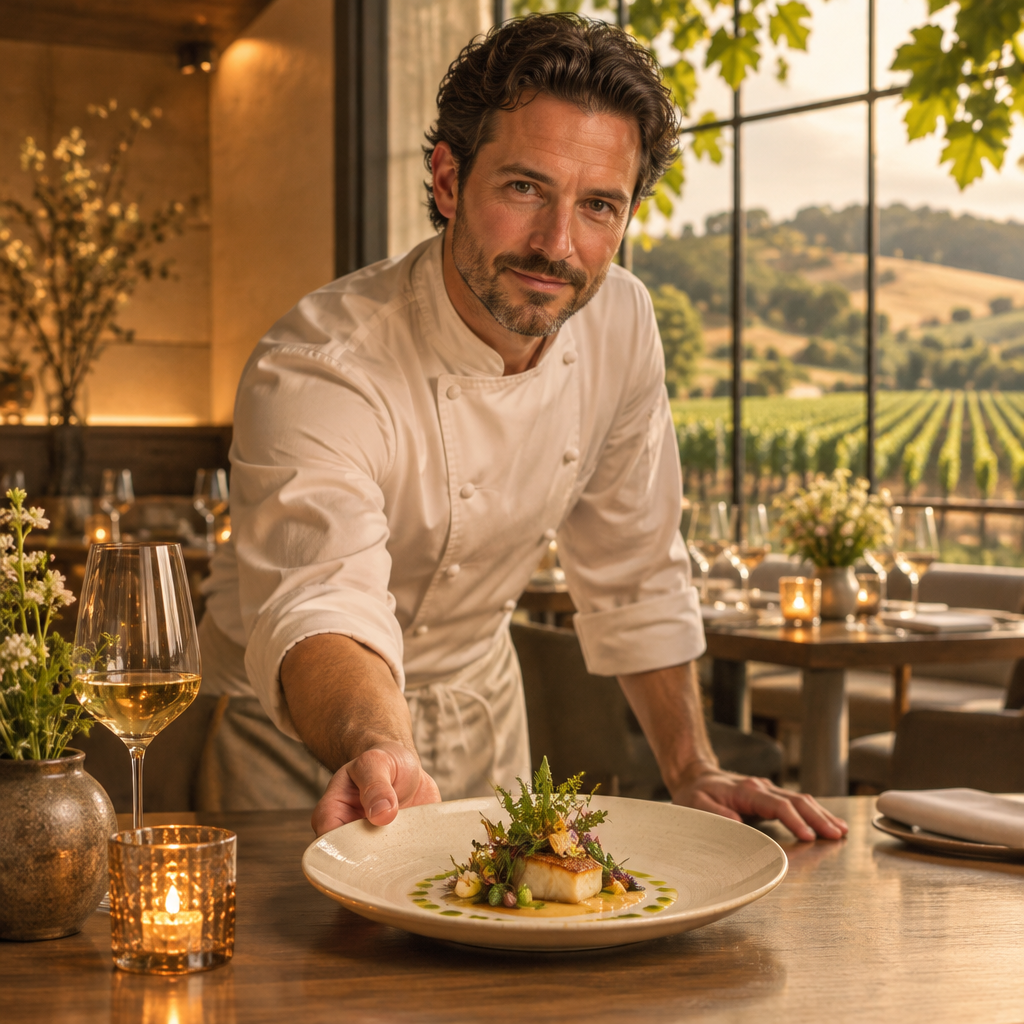
Enclos belongs to Stone Edge Farms Vineyards and Winery. Mac and Leslie McQuown selected Limoges to take charge of the restaurant, placing him at the center of a project with a clear regional setting. The tasting menu is described as a celebration of Sonoma, but it is not limited to place: it also reflects Limoges’s upbringing, French training, and the sensibility he sharpened in Michelin-starred kitchens.
That combination gives the restaurant a useful point of distinction. A regional menu can express where a restaurant sits; a chef’s personal history can explain how that place is interpreted. Limoges’s background provides both elements. The specific dishes and ingredients on the menu are not reported, so it would be careless to invent them. What is clear is the intention to bring region and personal experience together.
Why Enclos’s Recognition Matters
Michelin recognition arrived quickly. Enclos received two stars when it opened, then rose to three, a progression that put both the restaurant and its 37-year-old executive chef in the international spotlight. The rapid ascent is the clearest measure of the restaurant’s early reception in the account available here; it is not a reason to assume that every detail of the dining experience is known.
- A broad professional route: He worked in Boston, San Francisco, England, and the Bay Area again before taking the Enclos role. That record shows movement across distinct working settings, though it does not tell us exactly what he learned in each kitchen.
- Experience at named, celebrated restaurants: Atelier Crenn, Quince, and Birdsong are part of his San Francisco history. His work with Simon Rogan adds an English chapter before his return to California.
- A leadership step: Limoges moved from a corporate chef role at Saison Group to leading Enclos as executive chef. The change marks a shift in the scope of his responsibilities, without revealing details about either job’s daily operations.
- A stated culinary point of view: Enclos’s tasting menu connects Sonoma with Limoges’s upbringing and French training. This is a more specific description than simply calling the food “fine dining.”
- Recognition attached to the restaurant’s first years: Two stars at opening and a later rise to three stars make Enclos’s early trajectory notable.
Fine dining is often described through awards, names, and price. Those markers are easy to repeat and not always useful on their own. Here, the more meaningful detail is the link between a chef’s accumulated experience and a menu intended to reflect its region. Craft matters because skilled work gives form to an idea; beauty in food is not merely decoration when it expresses care, place, and labor.
How to Read Limoges’s Career Path
Limoges’s route to Enclos can be understood in stages. The sequence matters, but it should not be treated as a formula that guarantees a particular outcome.
- Formal culinary education. Limoges graduated from the New England Culinary Institute. That establishes a foundation in culinary training, though the specific subjects, instructors, or methods are not reported.
- Early professional work. He worked in Boston kitchens after growing up in the Northeast. The available account does not name those kitchens, so their individual influence cannot be assessed.
- A move west. Limoges went to San Francisco to hone his craft. His stints at Atelier Crenn, Quince, and Birdsong mark this stage, placing him in several of the city’s celebrated restaurants.
- Experience abroad. He worked for Simon Rogan in England. The account does not identify the specific restaurant or describe his position there, so it is best not to add detail.
- Return and broader leadership. Back in the Bay Area, he took a corporate chef role for Saison Group. That role came before his appointment at Enclos.
- A restaurant of his own to lead. Mac and Leslie McQuown tapped him as executive chef for Enclos, which opened in Sonoma in 2024. The menu’s stated themes—region, upbringing, and French training—offer a concise guide to its intended character.
- Recognition. Michelin awarded Enclos two stars at opening, and it later climbed to three. That recognition is a milestone, not a substitute for understanding the menu or the work behind it.
When I assess this career arc, I look for what is documented rather than what a polished biography might imply. The sequence supports a reading of steady professional development across several settings. It does not establish a personal philosophy beyond what is explicitly stated, nor does it reveal which specific dishes carry that philosophy. That distinction keeps praise grounded.
Career Comparison: Enclos and the Earlier Roles
| Career stage | What is reported | What it tells us |
|---|
| Boston kitchens | Limoges worked in Boston after graduating from the New England Culinary Institute. | His professional cooking career began in the Northeast. The kitchens are not named. |
| San Francisco restaurants | He had stints at Atelier Crenn, Quince, and Birdsong. | His work moved into celebrated San Francisco kitchens. Individual duties are not reported. |
| England | He worked for Simon Rogan. | His career included a period in England; the specific venue and role are not identified. |
| Saison Group | He returned to the Bay Area for a corporate chef role. | This position came before his move to Enclos. The job’s scope is not described. |
| Enclos | He became executive chef when the Sonoma restaurant opened in 2024. | He was tapped to lead the restaurant and its tasting menu. Michelin recognition followed quickly. |
This is a comparison of career stages, not a ranking of competing restaurants. No direct competitor or comparative performance data is identified, so naming one would add unsupported claims. The table instead shows the change in Limoges’s role: from work across established kitchens and a corporate chef position to executive leadership at Enclos.
Common Mistakes When Assessing a Celebrated Restaurant
Treating Michelin stars as the whole story. Michelin’s recognition is a notable fact about Enclos, but a star count does not tell us the menu’s dishes, the service style, or what an individual diner will value. The reported progression—from two stars at opening to three—deserves attention without being made to stand in for every aspect of the restaurant.
Assuming a chef’s résumé explains every plate. Limoges’s work at Atelier Crenn, Quince, and Birdsong, his time with Simon Rogan, and his role at Saison Group are useful context. They do not prove that a particular technique or dish came from any one kitchen. Without that detail, assigning influences to specific elements would be guesswork.
Confusing regional focus with a list of local ingredients. Enclos’s tasting menu celebrates Sonoma, but the ingredients and producers are not named. The regional idea is reported; a detailed account of sourcing is not. Those are different claims.
Reading “French training” as a complete culinary description. French training is one element of the menu’s stated identity, alongside Limoges’s upbringing and the region. It would be too simple to reduce the restaurant’s approach to one influence, especially when the menu is described as a blend.
Turning a rapid rise into a prediction. The restaurant opened in 2024, earned two stars at the outset, and later reached three. That is a striking early record. It does not establish what will happen next, and a responsible account should not pretend to know.
Overlooking the work behind the acclaim. Awards give a concise public marker, but a restaurant is also built through skilled labor. Limoges’s route includes formal training, kitchen work, and leadership roles. Recognizing craftsmanship means respecting the discipline and people behind the finished experience, not merely admiring the distinction attached to it.
Frankly, the strongest account is also the most restrained: Enclos has earned major recognition, and its chef has a substantial, geographically varied career. The rest should be described only when details are available.
Frequently Asked Questions
Who is the executive chef of Enclos?
Brian Limoges is the executive chef of Enclos. Mac and Leslie McQuown tapped him to lead the restaurant when it opened in Sonoma in 2024.
What is Enclos’s menu known for?
Its tasting menu celebrates the region, Limoges’s upbringing, and his French training, with a sensibility shaped by his work in Michelin-starred kitchens. Specific dishes are not reported here.
How many Michelin stars does Enclos have?
Enclos received two Michelin stars at opening and later rose to three. The timing is described as rapid, but no specific date for the third star is provided.
Where has Brian Limoges worked?
His career includes Boston kitchens, Atelier Crenn, Quince, and Birdsong in San Francisco, work for Simon Rogan in England, and a corporate chef position with Saison Group in the Bay Area. The specific Boston kitchens and his particular roles at several of these workplaces are not reported.
Final Thought
Enclos’s rise to three Michelin stars gives the restaurant an unusually prominent early profile, while Limoges’s career supplies a clear account of how he arrived at its helm. He trained at the New England Culinary Institute, worked in Boston, moved through celebrated San Francisco kitchens, spent time in England, returned to the Bay Area, and then took on the executive chef role in Sonoma.
The restaurant’s stated ambition is more interesting than a simple collection of credentials: its tasting menu brings together region, upbringing, and French training. That is a compact but meaningful framework for a chef’s work. It acknowledges that a meal can express both a place and the person shaping it, while leaving the food itself to do the proving.
For now, the facts support a measured conclusion. Limoges is a rising chef whose career spans several important stages, and Enclos has earned rapid Michelin recognition. The craft behind that recognition deserves respect; the claims made about it should remain as precise as the work demands.