Carroll Shelby’s own Shelby Daytona coupe matters because it combines <strong>race history, creator ownership, rarity, and provenance</strong> in one...
Carroll Shelby’s own Shelby Daytona coupe matters because it combines race history, creator ownership, rarity, and provenance in one brutally desirable package. The only example owned by Shelby himself is not just another expensive old car. It is a singular artifact, and the market has a habit of paying absurd sums for singular things.
Key Takeaways
- The car is the only Shelby Daytona owned by Carroll Shelby.
- Provenance is doing most of the heavy lifting here, not just horsepower.
- Auction estimates above $25 million reflect scarcity, history, and story.
- Buyers at this level pay for ownership chain, authenticity, and cultural weight.
- The Daytona’s value sits at the intersection of motorsport heritage and collectible art.
What is Carroll Shelby’s own Shelby Daytona? It is one of the most important American racing cars ever built, and the only one directly tied to its creator’s personal ownership. That distinction sounds small until you know how collector markets work. Then it becomes the whole ballgame.
The Shelby Daytona Coupe was born from competition, not luxury theater. It was engineered to beat Ferrari at its own game in the early 1960s, and it did. Carroll Shelby and his team wanted speed, stability, and a shape that could hold together at race pace. They got all three. The coupe became a legend because it was effective, not because it was polished for display.
That matters. Most auction headlines lean on drama and polish. Frankly, much of the time it is marketing smoke. But in this case the hype has substance. A car with direct links to Shelby himself, especially the only Daytona he owned, carries a kind of proof that no restoration shop can fake. It has the smell of history on it, if that makes sense. The good kind.
When I analyze cars like this, I look past the auction estimate and ask a simpler question: what makes this object irreplaceable? Here, the answer is straightforward. The car has race pedigree, brand mythology, and a personal chain of custody that gives collectors something close to relic status. That last part matters more than people admit. Luxury is rarely just about cost. It is about recognized significance, and in a well-ordered world, beauty and excellence should point beyond themselves, however faintly, to the value of disciplined human work.
You can see that principle in the broader collector market too. Sotheby’s has repeatedly shown how provenance changes value, whether the item is a watch, a handbag, or a car. Bonhams and RM Sotheby’s have built businesses around the same truth. A good object becomes a great one when the story is clean and the evidence is solid. A famous owner is not enough by itself. But when the object is already rare, already important, and already winning on the track, a famous owner becomes gasoline on a fire.
The Daytona’s estimate reportedly pushing beyond $25 million is not random. It reflects a market that prizes documented originality, racing success, and ownership provenance. Collectors at this level are not buying transportation. They are buying a verified chapter of motorsport history. And they usually want the chapter that nobody else can have.
For additional context on collector-car valuation and premium automotive culture, see reporting from Sotheby’s and broader auction coverage at RM Sotheby’s.
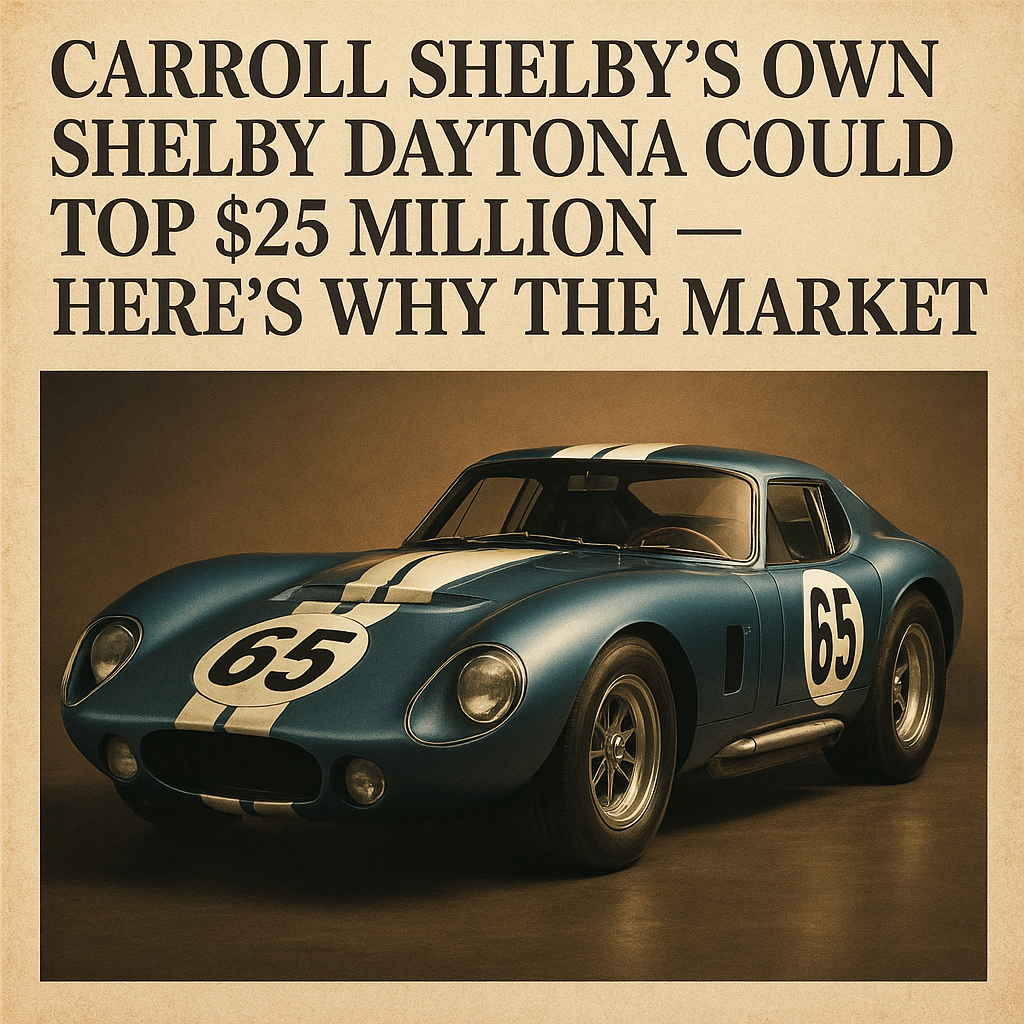
What separates this Daytona from the pack? Scarcity, mostly, but also emotional gravity.
A Ferrari Daytona can be bought. Another Shelby can be found. Another race car from the era will surface eventually. But the single Daytona that belonged to Carroll Shelby himself sits in a category of one. That is the kicker. The collector market loves categories of one, because categories of one resist comparison, and pricing something you cannot compare is a beautiful nuisance for anyone trying to save money.
Why does that matter now? Because the upper end of the market is increasingly driven by provenance and authenticity rather than by sheer mechanical specification. Horsepower numbers age. Documentation ages better. A rare thing with the right paper trail can cross from car territory into cultural artifact territory, and that transition is where the big money lives.
The Daytona is also part of a smaller and more serious class of American automotive icons. It represents ingenuity, grit, and a refusal to accept second place. That is not sentimental fluff. It is the reason collectors keep circling back to the car. It is the reason a $25 million estimate does not sound ridiculous to seasoned observers.
The car is not valuable because it is old. Plenty of old things are cheap. It is valuable because it is old and meaningful and irreplaceable. Those three together create a market force that money alone cannot manufacture.
What is Carroll Shelby’s own Shelby Daytona?
The Shelby Daytona Coupe was a purpose-built race car designed by Carroll Shelby and his team to defeat the dominant European GT cars of the era, especially Ferrari. It is one of the most celebrated American race cars ever made, famous for its speed, aerodynamic shape, and success in competition. Shelby’s personal example stands apart because he owned it himself.
That last fact is the engine of the story. The only example owned by its creator has a provenance layer that makes collectors sit up straight. Anyone can build a replica. Anyone can restore an old chassis. But you cannot recreate a direct link to Shelby’s own garage, his own use, and his own stewardship of the machine. That is where the serious value lives.
I’ve reviewed enough high-end collectibles to know that buyers tell themselves they love engineering, but what they really pay for is certainty. Certainty about identity. Certainty about history. Certainty that the object is not a clever forgery or a mess of replacement parts with a shiny paint job. In the Daytona’s case, the certainty is unusually strong. The car’s place in motorsport history is well established, and its connection to Shelby gives it an almost museum-grade aura.
The market also rewards the fact that the Daytona was not a vanity project. It was a weapon. It existed to win races, and it did. That matters because serious collectors tend to respect objects that were made to solve hard problems. The car’s design was not decorative. It was practical in the old, noble sense—form following purpose, a principle that still separates real design from cosplay.
Auction estimates above $25 million make sense when you stack the variables: rarity, race success, creator ownership, and the current appetite for top-tier American performance history. The figure is not just about chrome and nostalgia. It reflects the value of a verified story with almost no substitutes.
For a helpful primer on why race cars with provenance command premium prices, review coverage from Bonhams and this collector-market overview from Gooding & Company.
Core benefits and why the market cares
The Daytona’s appeal is not complicated. It is rare, famous, and tied to a name that still means something in the car world. But let’s not pretend every famous car deserves nine figures. Most do not. This one does because the case is unusually strong.
- Provenance premium: The fact that Shelby owned it personally raises the stakes. Provenance is not decoration. It is value.
- Motorsport significance: The Daytona helped rewrite the GT racing story. That historical role keeps demand high.
- Only-one status: Being the only Shelby-owned example creates an extreme scarcity event. Collectors love extremity when it is verifiable.
- Cross-market appeal: It attracts car collectors, history buyers, and museum-level institutions. More bidders, more pressure.
- Cultural weight: Shelby is not just a brand. He is an American performance myth with receipts.
Here’s the truth. Luxury markets run on trust, ego, and evidence. In this case, the evidence is strong enough to survive the ego. That is why the estimate feels plausible instead of silly.
Another point people miss: this car is not merely a beautiful object. It is a record of skilled labor. Engineers, fabricators, mechanics, and drivers all put effort into creating something that worked at high speed under pressure. That dignity of work matters. It is easy to romanticize the final product and forget the hands that made it possible. But serious collectors do not forget. They pay for the work, the risk, and the result.
There is also the moral logic of stewardship. A car like this should not be treated as disposable entertainment. It should be preserved, documented, and maintained with care. That is not preachy. It is common sense. Objects of rare excellence deserve proper custodianship, not casual ownership.
From an investment perspective, the Daytona also benefits from a market bias toward objects that are both finite and narratively rich. Watches do this. Handbags do this. Fine art certainly does this. A Shelby Daytona does it in metal, fiberglass, and gasoline.

Step-by-step guide to evaluating a car like this
If you are trying to judge whether a classic car belongs in the stratosphere, I’d use a hard-nosed process. Not the fairy tale version. The real one.
- Verify provenance first. Start with ownership history, factory records, period photos, race logs, and restoration documentation. If the paper trail is weak, the price should be weak too. Simple.
- Measure historical relevance. Ask what the car changed. Did it win important races? Did it shape a category? Did it alter the way people thought about performance? The Daytona answers yes.
- Check originality and restoration quality. Over-restored cars can look perfect and still be disappointing. Collectors at the top want correctness, not just shine.
- Assess uniqueness. A single-owner link to Carroll Shelby is not a minor footnote. It is the core asset. A car can be rare in a weak way or rare in a world-class way. This is the second.
- Study auction comps, but don’t worship them. Comparables are useful, yet each hero car is its own beast. I’ve seen people hide behind comps because they are afraid to think. Don’t do that.
- Estimate institutional interest. If museums, private collections, and marque historians all care, then the market depth is real.
- Think about long-term stewardship. A car like this is not a flip. It is a responsibility. The best owners understand that value follows care.
The common mistake is assuming the highest bidder is always the smartest bidder. Not true. Sometimes the smartest bidder is the one who understands what it means to own a piece of history and preserve it without mutilating it for vanity’s sake.
I’ve watched collectors pay up for objects that look ordinary until the file folder opens. Then the room changes. The Daytona is exactly that kind of object. The car is impressive by sight, but it becomes formidable when the record is laid out. History, documentation, and significance do the work.
There is a practical lesson here for all luxury categories: exceptional items are evaluated on layers, not labels. The label matters, sure. But the layers—craft, authenticity, provenance, condition, and story—are what justify the premium.
Comparison table
| Factor | Shelby Daytona owned by Carroll Shelby | Typical vintage Ferrari GT car |
|---|
| Provenance | Direct creator ownership | Famous ownership possible, but not unique by default |
| Rarity | One-of-one ownership story | Rare, but usually multiple examples exist |
| Racing history | Major motorsport significance | Strong racing pedigree, often celebrated |
| Market appeal | Collector, museum, and Shelby enthusiasts | Collector and museum demand, broader legacy market |
| Price ceiling | Potentially above $25M | Often high, but comparable examples vary widely |
| Emotional pull | American icon, creator-linked artifact | European prestige, historic cachet |
| Investment logic | Provenance-driven premium | Condition and history-driven premium |
Common mistakes to avoid
People get sloppy with hero cars. Then they pay for it.
- Confusing fame with value: A famous name does not guarantee a high hammer price. The car needs substance.
- Ignoring documentation: If the records are thin, the story is weak. No amount of polishing fixes that.
- Overrating cosmetic condition: Shine is cheap compared with authenticity.
- Assuming auction estimates are gospel: Estimates are signals, not scripture. They guide bidders, but they do not force reality.
- Treating provenance as optional: In this segment, provenance is the main event.
- Forgetting the market context: High-end buyers care about broader trends—rare American performance cars, blue-chip collectibles, and institutional demand.
Frankly, a lot of classic-car commentary is lazy. People repeat the same phrases—“legendary,” “iconic,” “investment-grade”—without ever explaining why. The answer is usually some combination of scarcity, story, and documented importance. This Daytona has all three, which is why the estimate is credible.
There is also a spiritual caution, quietly relevant here: wealth without stewardship is a mess. Luxury, at its best, is not accumulation for its own sake. It is the careful enjoyment of fine things that were honestly made, rightly preserved, and wisely handed on. When that principle is missing, value turns hollow fast.
For more market context, see Hagerty’s valuation coverage and auction reporting from Sotheby’s.
Frequently asked questions
Why is Carroll Shelby’s own Daytona worth so much?
Because it combines rarity, creator ownership, racing history, and impeccable provenance. That combination is unusually powerful in the collector market.
Is the Shelby Daytona one of the most important American race cars?
Yes. It is widely regarded as one of the most significant American GT race cars ever built, especially because it helped Shelby’s team compete directly with European heavyweights.
Does creator ownership really add that much value?
Absolutely. In elite collectibles, direct ownership by the creator can transform a rare object into a singular artifact. That is the difference between expensive and exceptional.
Could it actually sell for more than $25 million?
Yes, that estimate is plausible if the right bidders show up. When a car is this important and this unique, the ceiling depends on competition as much as it depends on the object itself.
Final thought
Carroll Shelby’s own Daytona is not just a very expensive old race car. It is a clean, rare intersection of human ingenuity, documented history, and ownership with meaning. That is why the number gets so high. The market is not paying for nostalgia alone. It is paying for proof.
I think that is what separates serious luxury from merely loud luxury. Real luxury is disciplined. It respects craft. It values endurance over noise. It rewards the people who made something well and the people who kept it intact. The Shelby Daytona fits that standard almost unnervingly well.
And that is why the estimate can climb past $25 million without looking absurd. It is one of those rare cases where the story, the metal, and the record all agree. In this business, that is as close to fair as it gets.