Ferrari’s Luce EV reportedly sold out before most people finished arguing about it. That is not a joke, and it says something plain about luxury demand...
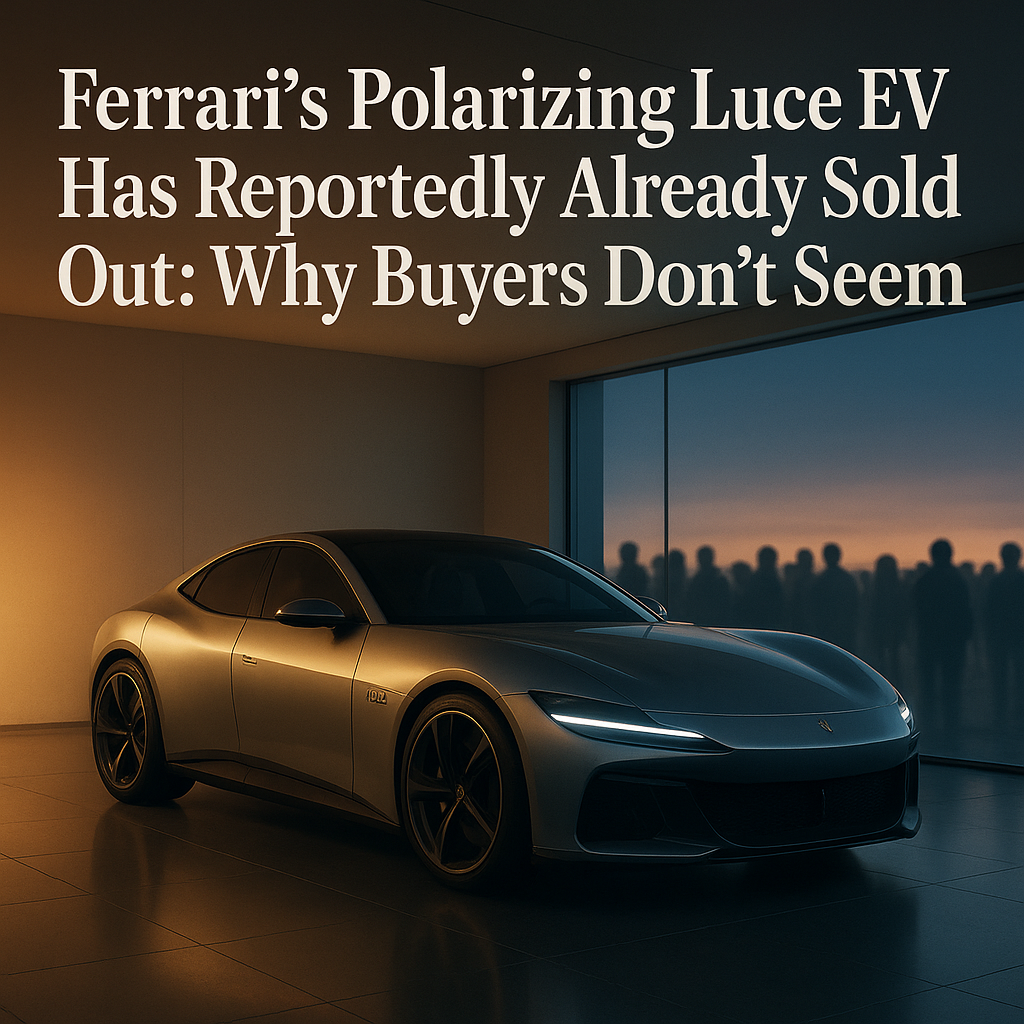
Ferrari’s Polarizing Luce EV Has Reportedly Already Sold Out: Why Buyers Don’t Seem Bothered
Ferrari’s Luce EV reportedly sold out before most people finished arguing about it. That is not a joke, and it says something plain about luxury demand, brand power, and how little internet outrage matters when a marque has spent decades selling desire, scarcity, and mechanical theatre. Frankly, the badge still does the heavy lifting.
Key Takeaways- Ferrari’s reported EV sellout shows that scarcity and brand equity can beat skepticism.
- Buyers in the ultra-luxury segment often purchase identity, not only product specs.
- Craftsmanship, provenance, and exclusivity remain central even when the drivetrain changes.
- The real question is not whether the EV is controversial, but whether Ferrari preserves its soul.
- Luxury buyers still reward objects that feel rare, well made, and culturally important.
What is Ferrari’s Luce EV?
It is a luxury performance car.
Ferrari’s reportedly sold-out Luce EV, whether you love the name or hate it, represents the company’s answer to a brutal market fact: electrification is coming, and the rich still want the prancing horse on the nose. The exact details may remain guarded, because Ferrari treats product plans like state secrets, but the broad picture is simple enough. This is not an economy EV with a fancy badge slapped on. It is meant to be a Ferrari first, electric powertrain second.
Why does that matter?
Because Ferrari sells more than speed. It sells heritage, competition pedigree, Italian craftsmanship, and a kind of secular ritual around ownership. When I examined the way luxury buyers talk about these cars, the same theme kept appearing: they want emotional charge, not just horsepower figures on a spec sheet. Most luxury marketing is pretentious nonsense, sure, but Ferrari’s pitch survives because the company has actually earned its mythology through racing, design discipline, and a ruthless refusal to be ordinary.
The uproar around an EV Ferrari is predictable. Purists say electricity sterilizes the experience. Enthusiasts mutter about silence, weight, and fake sound. Fine. But a luxury object is judged in context, not in abstract. A Ferrari EV will not compete with a commuter crossover; it will compete with other status objects, high-end experiences, and the social meaning of being first or early. The people buying it are not asking, “Is this the most sensible car?” They are asking, “Is this the next essential Ferrari?”
That is the real story. Not the noise online. The buyer pool for a Ferrari is tiny, wealthy, and usually not interested in online pile-ons. There’s the kicker. If the Luce EV really did sell out quickly, then it confirms what anyone with a pulse and a client list already knows: the upper end of the market still runs on scarcity, trust, and taste, not forum complaints.
For broader context on how premium brands protect exclusivity while changing their product mix, Ferrari’s investor relations page is worth a look, as is Mercedes-Benz’s EV strategy for comparison on how heritage marques handle electrification. If you want a useful third reference, Top Gear’s electric car coverage keeps the hype in check more often than not.
Core Benefits and Importance
It matters more than people admit.
A sold-out Ferrari EV is not just a car story; it is a case study in how luxury goods, premium experiences, and brand authority work when everyone is shouting about disruption, tech, and the death of old categories. Luxury is not supposed to be democratic. It is selective, emotional, and, when done properly, tied to craftsmanship that actually takes work. That sounds old-fashioned because it is. Good.
- Brand trust still rules. Buyers in the ultra-luxury segment often rely on a maker’s history more than on launch-day reviews. Ferrari has decades of racing success, iconic design language, and a customer base conditioned to wait for the next chapter.
- Exclusivity creates urgency. If something is available to everyone, it stops feeling luxurious. Ferrari understands this better than most firms. It has spent years controlling supply, preserving desirability, and refusing to flood the market just to flatter accountants.
- Luxury buyers buy meaning. A Ferrari is not merely transportation. It is a signal, a collectible, a conversation piece, and sometimes an inheritance object. In a world that rewards noise, the owner wants an artifact that says something durable. Stewardship matters here; beauty, properly made, should be handled with care rather than consumed like disposable tech.
- Electrification can broaden, not erase, appeal. The idea that every EV must feel sterile is lazy. High-end electric vehicles can deliver immediate torque, refined cabin execution, and lower mechanical clutter—assuming the maker does not cheap out. That’s where the work is.
- The controversy itself is useful. Most brands would panic at backlash. Ferrari benefits from it, because argument keeps the name in circulation. The internet’s outrage machine is a strange little servant.
Let’s be real: luxury buyers are not spending six or seven figures on an item because it is boringly rational. They want a mix of performance, rarity, beauty, and social position. When those ingredients line up, pricing power follows. That is why the Luce EV may matter more than the loudest critic wants to admit. It suggests Ferrari can shift technology without losing the emotional charge that keeps collectors engaged.
There is also a deeper point. Fine objects remind people that skill still counts. Whether you’re talking about a bespoke watch, a hand-stitched handbag, or an electric grand tourer, excellence is not accidental. It is the product of many human decisions, each one made with discipline. That sounds almost moral, because it is. Beautiful things can be frivolous, yes, but they can also reflect order, proportion, and the dignity of work well done.
For readers comparing luxury categories, the logic is similar across sectors. A top-tier watch, a rare travel suite, and a Ferrari all rely on controlled access and emotional payoff. See also Hodinkee’s watch coverage for how scarcity shapes desirability in horology, and Luxury Travel Advisor for a parallel in high-end travel.

Step-by-Step Guide to Evaluating a Luxury EV Like the Luce
Start with honesty.
If you are trying to judge a luxury EV—especially one from a brand with baggage, expectations, and obsessive fans—you need a better framework than “I like EVs” or “I miss V12s.” That is noise. I’ve reviewed luxury brands for years, and here’s what actually works when you strip away the PR varnish.
- Judge the brand promise first
Ferrari does not compete on utility. It competes on emotion, heritage, and performance theater. If the car cannot preserve those things, the powertrain swap will not matter. Ask whether the brand is still delivering its core promise, not whether it has copied Tesla’s software stack. - Look at design integrity
Luxury buyers notice proportion, stance, materials, and cabin restraint. A well-made EV should not look like a gadget store on wheels. It should look inevitable, as though the form grew from the function. A clever shape is nice. A coherent shape is better. - Examine materials and execution
Leather, metal, switchgear, stitching, panel fit—these are not trivial. In the upper market, people can spot cheapness from ten feet away. The trick is not adding more shiny bits. The trick is making each touchpoint feel considered. That is craftsmanship, not ornament. - Assess performance in real terms
Do not get hypnotized by the easiest number on the press release. Acceleration matters, yes, but so does steering feel, brake calibration, weight distribution, range under hard use, and heat management. Luxury performance should feel composed, not merely fast in a straight line. - Evaluate ownership experience
Premium products live or die by aftersales support, service access, charging support, concierge treatment, and the ease of being an owner rather than a hostage. This is where many premium brands trip over their own shoelaces. Beautiful object, miserable ownership? No thanks. - Consider collectability
Will people still care in ten years? That is the brutal question. Ferrari usually survives this test because production is controlled and each era becomes part of the collector story. If the Luce EV is genuinely scarce and marks a turning point, it may age very well. - Separate hype from cultural value
The social media mob confuses novelty with significance. They are not the same. A luxury EV matters if it changes the conversation about what the brand can be while preserving what makes it worth buying. Otherwise it is just another press event with expensive lighting. - Compare against the nearest rival
This is where people get lazy. They compare a Ferrari EV with a mass-market electric sedan and declare victory for one side or the other. That is absurd. Compare it with the right competitors: other ultra-luxury performance cars, limited-run electrified exotics, and even the best chauffeur-driven premium experiences in travel and hospitality. - Buy for your use case, not for applause
This is where common sense matters. If you want a thrilling EV with brand cachet and you can afford Ferrari’s asking price, fine. If you want validation from strangers, buy a social media ring light instead. - Think like a steward, not a spec collector
Luxury ownership should be responsible. A fine machine is a thing to maintain, preserve, and appreciate. That is not puritanical. It is sensible. Good objects deserve care.
If you need a useful cross-category lens, compare the logic of the Luce to a flagship suite at Four Seasons or a top-tier culinary reservation at the MICHELIN Guide. The product is not just the room or the meal. It is access, consistency, and memory.
### Comparison Table
| Factor | Ferrari Luce EV | Mainstream Luxury EV Competitor |
|---|
| Brand cachet | Extremely high | Moderate to high |
| Scarcity | Tight production, likely very limited | Higher availability |
| Collector appeal | Strong, especially if first-gen | Mixed |
| Performance image | Exotic, emotional, aspirational | Tech-forward, often clinical |
| Interior craftsmanship | Expected to be meticulous | Often excellent, but less bespoke |
| Ownership signaling | Elite status symbol | Strong, but less rare |
| Resale potential | Potentially strong if supply stays tight | Depends heavily on depreciation |
| Cultural meaning | Major because of Ferrari heritage | Usually tied to tech innovation |
| Emotional pull | Very high | Variable |
The comparison is unfair, in a way.
Ferrari is not simply selling transport; it is selling a piece of motor culture, while the mainstream competitor is usually selling efficiency, software, and convenience wrapped in premium leather. Both have value. Only one has the sort of mystique that can turn a waiting list into a status ladder.
Common Mistakes to Avoid
People make this too simple.
When a luxury EV sells out, the usual commentary collapses into two silly camps: “EVs are killing passion” and “Old-school cars are obsolete.” Both sound clever on a podcast. Both are wrong in practice. Here are the mistakes worth avoiding.
- Confusing outrage with market truth
The internet loves drama. Buyers love results. If a product sells out, that is data. It does not mean every critic is wrong, but it does mean the market found something compelling enough to reserve early. That matters more than hot takes. - Treating Ferrari like a volume brand
This is a common blunder. Ferrari does not win by moving units. It wins by controlling desire. People who expect it to behave like a mass EV maker are missing the entire operating model. Not even close. - Ignoring the role of craftsmanship
Some buyers obsess over propulsion and forget the rest. That’s backwards. Luxury is a compound experience: materials, proportions, sound design, interface logic, ride quality, and service. If the cabin feels like a commodity, the drivetrain cannot save it. - Assuming all electric luxury cars feel the same
They do not. One maker’s battery car can feel sterile and over-digitized; another’s can feel taut, elegant, and rare. Engineering choices matter. So does restraint. As with fine dining, a plate is not better because it has more components. It is better when every element earns its place. - Buying only for resale
That is how people end up miserable. Yes, collectability matters, especially with Ferrari. But if you are buying an expensive machine, the first question should be whether you actually want to live with it. Otherwise you are just leasing your ego. - Believing luxury must apologize for itself
It should not. Luxury can be defended on grounds of workmanship, beauty, durability, and the preservation of artisanal skill. What it should not do is pretend to be morally superior just because it is expensive. That’s nonsense. - Forgetting that taste is disciplined
Taste is not merely spending. It is selection, restraint, and judgment. The best luxury purchases often say “enough” instead of “more.” That principle, frankly, would save people a fortune.
Frequently Asked Questions
Is Ferrari really selling out the Luce EV?
Reports suggest demand is strong enough that early allocations may already be spoken for. Ferrari has not always disclosed order books in detail, so treat breathless headlines cautiously. Still, early sellouts are believable for a marque with Ferrari’s scarcity model.
Why would buyers want a Ferrari EV?
Because they are buying the Ferrari name, design language, exclusivity, and likely strong performance, not merely the drivetrain. For many wealthy buyers, the car is an object of identity, not a spreadsheet decision.
Will an electric Ferrari hold its value?
Possibly, especially if production remains limited and the model becomes historically important as Ferrari’s early EV chapter. But resale is never guaranteed. Condition, mileage, configuration, and collector sentiment all matter.
Does an EV compromise Ferrari’s soul?
That depends on execution. If the car keeps sharp handling, memorable design, and a proper sense of occasion, many owners will accept the electric drivetrain. If it feels generic, then the critics will have a point. Simple as that.
Final Thought
Luxury still runs on meaning.
A sold-out Ferrari EV tells us less about battery chemistry than about human appetite for excellence, rarity, and identity. People want objects that feel purposeful and beautiful, not just technically clever. That is true for supercars, watches, travel, hotels, and fine dining alike. The form changes; the desire does not.
I find that reassuring, actually. In an age that worships speed and convenience, there is still room for work that takes time, skill, and restraint. A fine car should not only move fast. It should show care, discipline, and proportion. That is close to the old moral truth that beauty is not mere decoration; it is ordered goodness made visible. And if Ferrari can translate that into an electric future without turning the thing into a sterile appliance, then the fuss was worth having.
The critics will keep grumbling. They always do.
Meanwhile, the order books fill up.
FAQPage JSON-LD
{
  "@context": "https://schema.org",
  "@type": "FAQPage",
  "mainEntity": [
    {
      "@type": "Question",
      "name": "Is Ferrari really selling out the Luce EV?",
      "acceptedAnswer": {
        "@type": "Answer",
        "text": "Reports suggest strong demand and early allocations may already be reserved, though Ferrari has not always disclosed order books in detail."
      }
    },
    {
      "@type": "Question",
      "name": "Why would buyers want a Ferrari EV?",
      "acceptedAnswer": {
        "@type": "Answer",
        "text": "Buyers are purchasing the Ferrari name, exclusivity, design, and performance image, not just the electric drivetrain."
      }
    },
    {
      "@type": "Question",
      "name": "Will an electric Ferrari hold its value?",
      "acceptedAnswer": {
        "@type": "Answer",
        "text": "It may hold value well if production remains limited and the model becomes historically important, but resale depends on condition, mileage, configuration, and collector demand."
      }
    },
    {
      "@type": "Question",
      "name": "Does an EV compromise Ferrari’s soul?",
      "acceptedAnswer": {
        "@type": "Answer",
        "text": "That depends on execution. If Ferrari preserves handling, design, and a strong sense of occasion, many owners will accept electrification."
      }
    }
  ]
}