Fine-dining power is the ability to shape what restaurants cook, how they welcome guests, and which ideas survive commercially. It belongs not only to...
Fine Dining Power in America: Who Shapes the Restaurants We Eat At?
Fine-dining power is the ability to shape what restaurants cook, how they welcome guests, and which ideas survive commercially. It belongs not only to celebrated chefs, but also to restaurateurs, investors, developers, media figures, and the teams that keep hospitality running. The most useful measure is influence: creative, economic, and human.
That broader definition matters. A restaurant can be ambitious without demanding a three-hour tasting menu, and hospitality can be polished without feeling stiff. The 2026 Power List reflects that view, asking people across the industry to consider who moves the needle creatively and economically. Its voters included chefs, restaurateurs, investors, architects, and restaurant-technology leaders.
The profiles below offer a useful cross-section, not a complete account of all 50 people named. They show how influence can come from building a group of restaurants, developing a distinctive culinary voice, or directing resources toward hospitality workers. Frankly, those are different forms of power, and lumping them together without explanation makes a ranking less useful.
What Is Fine-Dining Power?
Fine-dining power is influence over the decisions and standards that shape ambitious restaurants. It can be visible in a chef’s dishes, but it also sits in ownership structures, capital, real estate, staffing, media attention, and the ability to keep a restaurant open. The definition matters because dinner is not made by a chef alone.
The 2026 list tried to account for that wider system. Its 150 voters could each nominate 10 people, and they could group a duo or trio when they considered the members’ influence inseparable. The voting pool was selected for gender, racial, age, and geographic diversity. Those choices broaden the lens, though the published account does not report individual ballots, weighting, or a complete breakdown of voter representation. A ranking should not be mistaken for a scientific measurement.
Consider the Nashville brothers Max and Ben Goldberg. Their Strategic Hospitality group, founded in 2006, includes Catbird Seat, Bastion, and Locust; the account describes those three as Nashville’s Michelin-starred restaurants. The group also runs the Broadway honky-tonk Friends in Low Places for Garth Brooks and Trisha Yearwood. That range—from fine-dining counters to a high-volume music venue—shows how ownership and local relationships can extend influence beyond a single kitchen. The group’s own website offers a view of its concepts at Strategic Hospitality.
Austin restaurateurs Tavel Bristol-Joseph and Kevin Fink illustrate another model. They began with Emmer & Rye in 2015, then developed concepts including Hestia, Canje, and other restaurants in Texas. Their work connects local ingredients and heirloom grains with wood-fired cooking and Caribbean flavors rooted in Bristol-Joseph’s Guyanese heritage. The account also describes their expansion into San Antonio’s Pearl District, where a former bottling factory became a restaurant grouping in 2024. Michelin’s Texas restaurant listings are a useful place to check current guide selections, which can change over time.
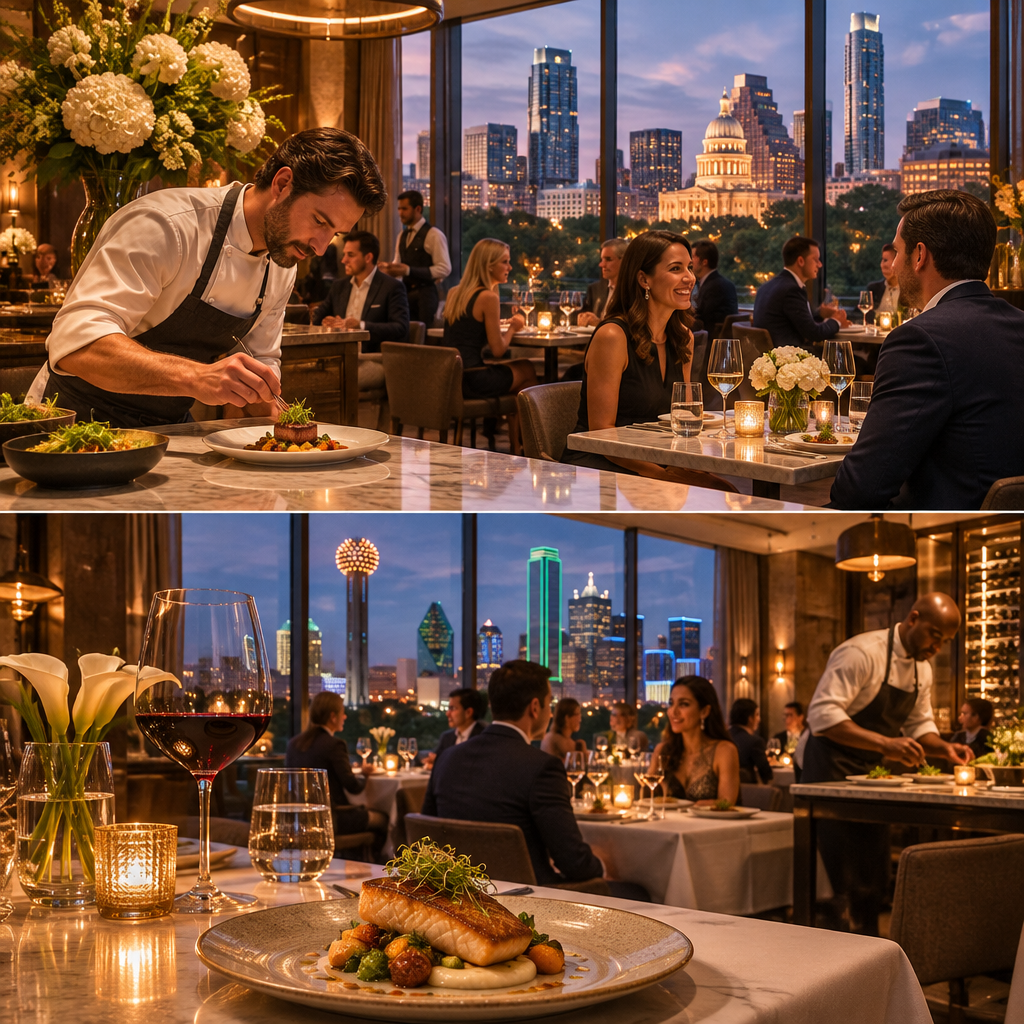
Power can also shift from restaurants to the people they serve. Chris Shepherd stepped away from his restaurant group in 2022 and focused with his wife, Lindsey Brown, on Southern Smoke, the organization they cofounded. Shepherd is its chair; Brown is executive director. Its work supports emergency relief and mental-health programs for hospitality workers. That is influence with a different measure: not reservations or reviews, but whether a worker can get help during hardship. Southern Smoke describes its work on its about page.
Why Fine-Dining Influence Matters
Influence shapes what diners encounter. It affects which ingredients reach menus, which neighborhoods attract restaurant investment, and whether a new style of cooking becomes a local reference point or a brief curiosity. It also influences the standards guests come to expect, for better or worse.
- Creative direction: A chef or restaurant group can make a region’s ingredients and histories part of a broader conversation. Underbelly, Shepherd’s Houston restaurant, drew on the city’s immigrant communities, combining flavors associated with Vietnam, Germany, Korea, and elsewhere with local ingredients. That approach treated a diverse city as a source of culinary knowledge, not merely a backdrop.
- Commercial durability: A restaurant idea needs more than applause. Groups that can build different formats—say, a tasting counter, a neighborhood restaurant, and a bar—may spread risk and reach more diners. Strategic Hospitality’s range is an example; it is not proof that every multi-concept group is well run or profitable. Those financial details are not reported here.
- Regional identity: Fink and Bristol-Joseph’s restaurants connect Texas dining with seasonal produce, heirloom grains, wood-fired techniques, and Caribbean cooking. A restaurant can give a place a sharper culinary identity while still speaking in the chef’s own voice. The tension between local roots and broad appeal is often where the interesting work happens.
- Public attention: Awards and guides can draw customers, staff, investors, and press. The James Beard Awards are one prominent source of recognition in American food, but a prize is not a complete measure of hospitality, financial health, or working conditions. Let’s be real: a medal does not run a Saturday service.
- Care for workers: The Southern Smoke example shows that influence can be used to address instability in the industry. Restaurant work is physically demanding and often exposed to sudden income loss, including disasters that close businesses. Emergency grants and mental-health support matter because skilled hospitality workers have dignity beyond the service they provide.
- Craft and stewardship: The best dining rooms treat ingredients, labor, and attention as things worth respecting. Beauty in a meal can point beyond display; careful work, fairly valued, reflects an appreciation for the people and gifts that make it possible. Luxury is more credible when it practices stewardship rather than waste.
Here’s the kicker: influence is not the same as virtue. A powerful operator can expand access to excellent food or simply expand a brand. A respected chef can change the way peers cook, while a restaurant with modest public attention may quietly provide exceptional care. The useful question is not just who is famous, but what their power produces.
How to Assess Fine-Dining Influence
A list is a starting point, not a verdict. When I assess a restaurant figure, I look for evidence of reach, the quality of the work, and the consequences for people who make the experience possible. This process works better than treating awards, celebrity, or a high menu price as a shortcut.
- Define the kind of influence. Separate creative influence from business growth, investment, media reach, property access, and worker support. A chef may shape menus across a city without owning many restaurants; a developer may determine which groups can secure a viable location. These are not interchangeable achievements.
- Look at the operating record. Count the concepts and locations that are actually described, then distinguish open operations from announced plans. The Goldberg group’s range is reported across Nashville venues; Fink and Bristol-Joseph’s reported portfolio extends from Austin into San Antonio. Do not infer revenue, profit, or job quality when those figures are not reported.
- Test the creative contribution. Ask what the food or service adds. Underbelly’s use of Houston’s cultural mix and local ingredients is a specific creative proposition; Canje’s connection to Bristol-Joseph’s Guyanese roots is another. A slogan about authenticity is not evidence by itself. Look for choices that appear in the menu and the experience.
- Check independent recognition carefully. Michelin stars and James Beard honors can help establish external recognition, but they answer narrower questions than the whole of a restaurant’s value. Michelin status changes, and awards represent particular criteria and judging processes. Confirm current listings rather than carrying old honors forward indefinitely.
- Include the people behind the room. Consider leadership, staff support, and whether the business contributes to the resilience of the wider industry. Southern Smoke’s emergency relief and mental-health programs make its work visible beyond a restaurant’s guest experience. That does not tell us every detail of employment practice, but it identifies a concrete form of contribution.
- Separate fame from measurable impact. A headline, a celebrity partnership, or an investor’s name may bring attention. Then ask what changed: Did a restaurant open? Did a new audience encounter a cuisine? Did a program put aid into workers’ hands? I trust specific outcomes more than prestige language.
- Read the ranking rules. In this case, 150 voters each selected 10 people, with linked duos or trios permitted. The account does not provide a scoring formula or ballot totals. That means readers should treat the list as an informed industry snapshot, not a precise league table with measurable gaps between entries.
This approach avoids a common trap: assuming that the most visible person has the most influence. Sometimes the person with the most leverage is a partner who secures financing, a property owner who leases a suitable space, or an executive who keeps a group’s operations coherent. Good analysis follows the mechanism, not merely the name on the door.
Comparison: Broad Industry Influence vs. Chef-Only Recognition
The strongest competitor to a broad power list is the familiar chef-centered model: rank the celebrated cooks, count the awards, and let the dining room’s public face stand in for the whole business. That model is simple and often appealing. It is also incomplete, because the 2026 list explicitly invited voters to consider investors, developers, media figures, and other operators alongside chefs.
| Measure | Broad fine-dining influence | Chef-only recognition |
|---|
| Who counts | Chefs, restaurateurs, investors, developers, media figures, and restaurant leaders | Primarily chefs and culinary figures |
| Voting basis in the 2026 list | 150 industry voters, each choosing up to 10 people | Not specified in the account; depends on the ranking |
| What it captures | Creative reach, commercial growth, access to capital and property, and public influence | Culinary authorship, reputation, and awards |
| Example from the profiles | The Goldbergs’ restaurant group; Southern Smoke’s worker support | Shepherd’s cooking at Underbelly and related concepts |
| Main limitation | Different kinds of power can be hard to compare, and the scoring formula is not reported | Can overlook the people and infrastructure behind a restaurant |
Neither model is automatically superior. The broad version can explain why an investor or developer matters, but it risks comparing unlike things as if they shared one unit. The chef-only version gives creative work its due but can hide the systems that allow a kitchen to function. The practical answer is to use a ranking for discovery, then read the evidence behind each name.
The available figures are modest but useful: 150 voters, 10 selections per voter, and permission to group closely linked collaborators. No ballot totals, market shares, or financial results are reported. That distinction matters. A table with hard numbers can look more exact than its underlying evidence, so it should never imply information that the list does not provide.
Common Mistakes to Avoid
A prestigious name can cloud judgment. Fine-dining coverage often uses shorthand—stars, awards, celebrity partners, expansion—that makes influence sound simpler than it is. The details matter more.
- Treating a ranking as an audited scorecard. The 2026 list describes a broad voting exercise, but the account does not report how each vote was weighted or how close one entry was to another. Do not invent a precise hierarchy from a list when the scoring details are unavailable. Its value is as a snapshot of peer perception.
- Reducing fine dining to white tablecloths. The list’s definition centers on ambition in the kitchen and attentive hospitality in the dining room, not one dress code or menu format. A casual restaurant can take its food seriously; a formal room can still deliver poor service. Atmosphere is part of the experience, not a substitute for substance.
- Assuming stars explain everything. Michelin recognition is useful, but it cannot answer whether a business is financially sound, generous to staff, or meaningful to its neighborhood. Nor should an old star be presented as current without checking. Awards identify recognition under a specific system; they do not settle every question a diner should ask.
- Confusing expansion with excellence. A growing group has reach, and reach can influence a city’s dining options. But the number of venues says little by itself about consistency, working conditions, or the quality of each concept. The source account describes portfolios and openings; it does not report their operating margins or labor policies.
- Giving all credit to the visible chef. Restaurants rely on partners, cooks, servers, managers, investors, suppliers, and landlords. A chef’s vision matters, but so does the structure that lets the room execute it night after night. Good hospitality is collective work, even when one name gets the headline.
- Treating charity as a substitute for good operations. Southern Smoke’s worker-support programs are a tangible contribution, but philanthropy does not independently establish the labor practices of any restaurant. Keep the claims separate. Praise documented support without assuming it answers every question about employment.
- Mistaking a celebrity association for cultural value. The Goldbergs’ work with Friends in Low Places is notable because it shows the range of their operation, not because a famous owner automatically makes a venue excellent. Celebrity can draw attention. What happens after the doors open is the better test.
- Using heritage as decoration. A chef’s background can inform a meaningful culinary point of view, as Bristol-Joseph’s Guyanese roots do in the account’s description of Canje. But identity should not be treated as a marketing label detached from the food. Look for sustained knowledge, care, and specificity.
Most luxury marketing is pretentious nonsense when it hides the work behind misty talk of exclusivity. A well-made meal does not need a grand theory to justify itself. It needs good ingredients, practiced hands, thoughtful service, and a business capable of honoring its promises.
Frequently Asked Questions
What does fine-dining power mean?
It means the ability to influence ambitious restaurants and the wider industry through food, hospitality, ownership, investment, property, media, or worker support. A chef’s creative voice is one source of power, but the people who finance, build, manage, and sustain restaurants also shape what diners experience. The term describes influence, not a guarantee of quality.
How was the 2026 American fine-dining Power List selected?
The published account says 150 people from across the restaurant world voted, including chefs, restaurateurs, investors, architects, and restaurant-technology leaders. Each voter could select 10 people, and a duo or trio could be entered together when its influence was considered inseparable. The account does not report ballot totals or a detailed scoring formula.
Why are restaurant groups and nonprofit leaders included?
Because influence does not stop at the kitchen pass. Restaurant groups can create multiple concepts and attract talent or investment, while nonprofit leaders can direct support to workers facing hardship. The Goldberg brothers’ multi-concept work and the Southern Smoke roles held by Chris Shepherd and Lindsey Brown show different routes to impact. They should be judged by different kinds of evidence.
Are Michelin stars a reliable measure of a restaurant’s value?
They are a meaningful form of recognition, but not a complete measure. A star can tell diners that a restaurant has been recognized by the Michelin Guide under its criteria; it does not reveal every detail of service, employment, financial health, or community value. Check current guide listings, since restaurant recognition can change.
Final Thought
The most revealing thing about a fine-dining power list is not the glamour of its names. It is the reminder that a restaurant is a chain of decisions: who gets funded, which ingredients are valued, what kind of room is built, how workers are treated, and whether guests are welcomed with care. Influence gathers wherever those decisions meet.
The three profiles here resist a single definition of success. The Goldberg brothers built a varied Nashville portfolio. Fink and Bristol-Joseph joined a distinctive culinary voice to restaurant growth across Texas. Shepherd and Brown turned their attention toward resources for hospitality workers. These are not identical accomplishments, and they do not need to be. Together, they make a stronger case for looking past the chef’s portrait and asking how power is used.
When I assess luxury dining, I value craft without confusing price with excellence. A meal can be lavish and hollow, or restrained and memorable; what matters is the intelligence of the cooking, the dignity of the work, and the generosity of the welcome. Fine dining earns its standing when its beauty is matched by responsibility. Otherwise, it is just an expensive room with good lighting.