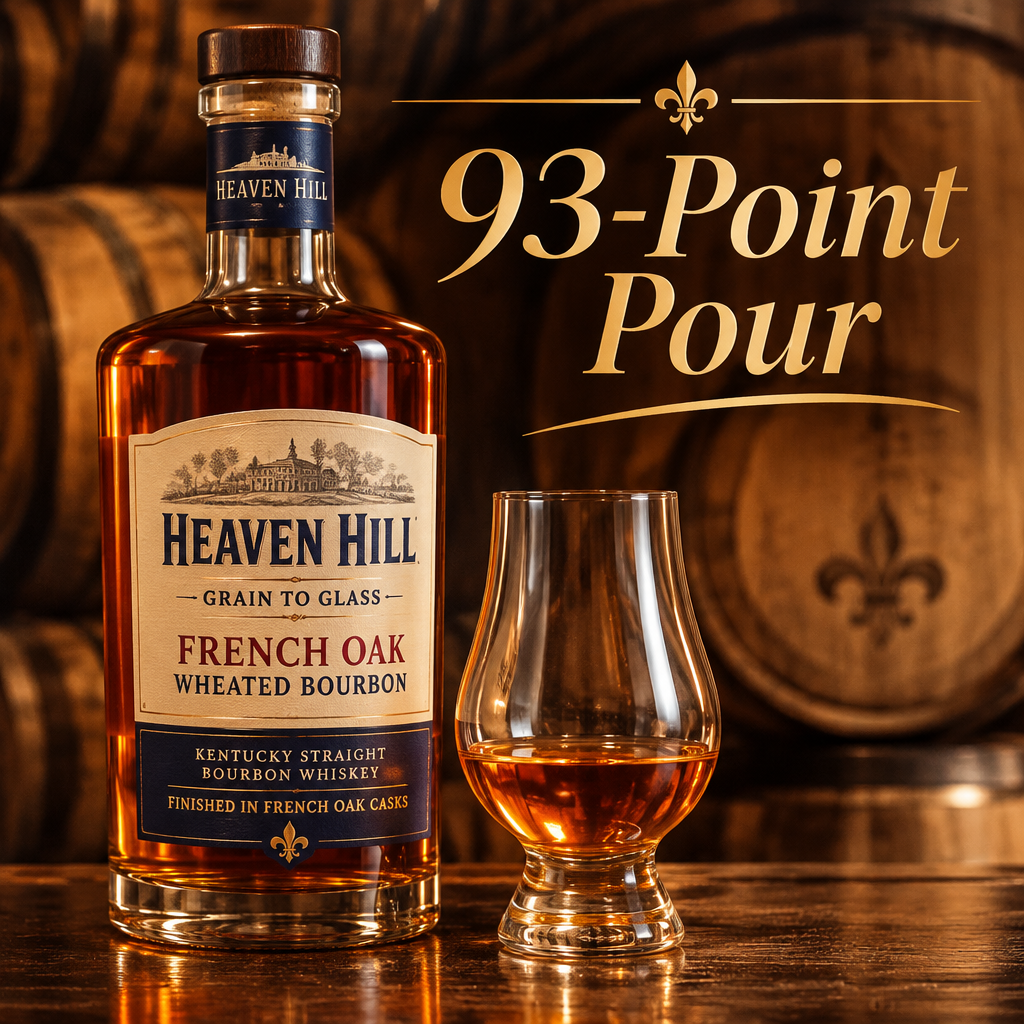
Heaven Hill Grain to Glass French Oak Wheated Bourbon Review: A 93-Point Pour
Heaven Hill’s Grain to Glass Specialty Barrel Wheated Bourbon trades the familiar new-charred American oak profile for full maturation in #3-char French oak. Made with Beck’s 6269 corn and a 35-percent wheat mashbill, it drinks dark and layered, with toast, cherrywood, orange, spice, and caramel. At 109.2 proof, it is a bold, unusually distinct bottle—not merely a finishing experiment.
Key Takeaways- This expression spent a minimum of six years maturing entirely in French oak; it was not simply finished in those barrels.
- Its mashbill is 52 percent Beck’s 6269 corn, 35 percent wheat, and 13 percent malted barley.
- Toasted oak, buttered toast, cherrywood, orange, baking spice, vanilla, milk chocolate, fruit, and caramel shape the tasting profile.
- The whiskey was bottled at 109.2 proof. Its reported score is 93/100.
The Grain to Glass series began with three expressions in 2024: straight bourbon, straight rye, and wheated bourbon. In its third year, the series shifted its attention to wheat, with three releases: a third edition of Kentucky Straight Wheated Bourbon, an Extra Aged 9-Year-Old Wheated Bourbon, and this Specialty Barrel expression. Heaven Hill’s Grain to Glass overview describes the series built around Beck’s Hybrids corn varietals; the specific varietal changes from year to year.
That farming-to-bottle idea is appealing, but a good story does not automatically make a good whiskey. Here, the barrel treatment supplies the clearest point of difference. The corn varietal may contribute something, but the French oak is the loudest voice in the glass—and, for once, the marketing hook has a genuinely interesting flavor to back it up.
What Is Heaven Hill Grain to Glass French Oak Wheated Bourbon?
It is a Kentucky straight wheated bourbon made with a mashbill of 52 percent corn, 35 percent wheat, and 13 percent malted barley. The corn is Beck’s 6269, a particular hybrid varietal used in the Grain to Glass program. In a wheated bourbon, wheat replaces rye as the secondary grain; that changes the recipe, though it does not promise a sweet, soft, or uncomplicated whiskey. The barrel, distillation, age, and warehouse conditions all have their say.
The standout production choice is maturation in #3-char French oak barrels for a minimum of six years. This is not a familiar American-oak bourbon given a short French-oak finish at the end. The French oak is the whiskey’s full maturation vessel, a distinction that matters when evaluating both its taste and its unusual dark color. Heaven Hill distilled the whiskey in 2019, entered it into the barrels at 107 proof, and aged 170 barrels on the fourth floor of Warehouse W9. It was bottled at barrel proof: 109.2.
That barrel choice sits comfortably alongside bourbon’s legal identity. Federal standards define bourbon by requirements including its corn content and storage in charred new oak containers; they do not say that the oak must be American. The federal standard of identity is worth a look for anyone who assumes French oak somehow disqualifies a whiskey from being bourbon. It does not. The key is meeting the applicable rules, not matching a familiar regional expectation for the wood.
French oak is often associated with Cognac maturation, and the category has its own established traditions around ageing and oak. The Bureau National Interprofessionnel du Cognac’s ageing information offers useful context, although Heaven Hill has not identified the precise French oak type used for this bourbon. It would be careless to label the barrels Limousin or Tronçais without confirmation. The distillery has disclosed the country of origin and char level, not the forest or cooperage details.
The result is unmistakably oak-driven, but not one-note. The first impression brings toasted oak and buttered toast; cherrywood, orange, baking spice, vanilla, milk chocolate, and bright fruit follow, with caramel carrying the finish. I would not pretend that a tasting note can isolate the influence of Beck’s 6269 corn from the influence of six-plus years in French oak. Still, as a complete whiskey—from grain choice through maturation—it has a coherent identity.
Core Benefits and Why the Bottle Matters
The first virtue is difference. Plenty of whiskeys can be described as well-made, balanced, or flavorful. Fewer give a drinker a clear reason to pause and ask what the wood is doing. Here, the French oak provides a strong sensory contrast with the vanilla-and-char familiar from many bourbon pours. Toasted wood, buttered toast, and cherrywood lead the conversation. The fruit and chocolate notes keep the oak from becoming a plank of lumber in a glass.
The second is that this is full maturation, not a quick finishing trick. A short secondary-barrel rest can add a surface layer; six years or more in one type of oak gives that vessel a more central role. The distinction does not make one method automatically superior. It does make this release more revealing as an experiment in barrel influence. Frankly, the label’s production choice is more compelling than a vague promise of “extra complexity.”
Third, the wheat-heavy recipe gives the bottle another point of comparison. Wheat can bring a different grain profile from rye, but it is a mistake to treat “wheated” as shorthand for gentle or sugary. This whiskey has enough oak, spice, and barrel-proof presence to hold its ground. The grain recipe and French oak do not operate as separate switches; they meet in the finished spirit, and the oak appears to dominate the first impression.
Fourth, the proof and disclosed production details make the tasting more useful. At 109.2 proof, the whiskey has enough weight to stand up to a small splash of water or a rich food pairing. Its entry proof was 107, and the bottling proof is 109.2; those are reported figures, not a license to invent a story about how the proof changed. The release also gives drinkers a mashbill, varietal, distillation year, barrel type, age minimum, warehouse location, and barrel count. That is more informative than a label padded with grand adjectives.
There is a premium experience here beyond collecting the bottle. Pour it slowly, give it a few minutes in the glass, and notice how toasted notes and fruit shift as the whiskey opens. Try it beside aged cheddar, roasted nuts, dark chocolate, or a restrained dessert rather than a table full of competing sweets. The point is attention, not ceremony for its own sake. Beauty can reward patient looking and tasting; good craft also honors the grain, wood, and skilled work that made the result possible. Moderation and stewardship belong at the table, too.
The main caveat is just as important as the praise: this may not be the best pick for someone seeking a classic, easygoing Heaven Hill profile. The French oak announces itself. If you want to taste the series’ corn varietal with minimal interference, this bottle may frustrate that goal. If you want to see how a different maturation vessel can reshape a wheated bourbon, it makes a strong case.
How to Choose and Taste It: A Step-by-Step Guide
- Decide what you want from the bottle. If your priority is a familiar bourbon profile, start with a more conventional new-charred American-oak expression. If your interest is a distinctly different barrel character, this Specialty Barrel release makes more sense. I find that identifying the reason for buying a premium bottle is more useful than chasing a score or a limited-release label.
- Read the production details, not just the front label. Look for the 52/35/13 mashbill, Beck’s 6269 corn, minimum six-year French-oak maturation, #3 char, and 109.2 proof. The 2019 distillation year and Warehouse W9 details add context, but they do not tell you exactly how every barrel tasted. A stated age is a minimum, not a promise that every note will resemble another whiskey of the same age.
- Start with a modest neat pour. Use a clean glass and avoid filling it to the brim. Smell from a little distance first, then bring the glass closer; barrel-proof whiskey can push alcohol heat forward if you nose it too aggressively. Let the first sip sit briefly on the palate. The toasted oak and buttered toast are useful anchors, while cherrywood, orange, vanilla, baking spice, milk chocolate, fruit, and caramel may emerge with time.
- Give the whiskey a few minutes. A new pour can seem more oak-forward than the next one. Take a second smell after several minutes, then compare the palate and finish. If the alcohol prickle obscures the flavors, add a few drops of water rather than a large splash. Water is not a correction. It is a tasting tool, and a small amount may make the fruit or chocolate easier to pick out.
- Try it with food, but keep the pairing simple. A firm, aged cheese can meet the oak without drowning the whiskey. Dark chocolate can echo its cocoa-like notes, while roasted nuts or a small serving of roast meat can provide a savory counterpoint. For a fine-dining setting, ask for the pour after the main course or with a deliberately modest dessert. Sugary sauces, heavily spiced dishes, and multiple competing flavors can make it harder to judge the whiskey itself.
- Judge value only after checking the actual price and your own preferences. No price is stated here, so a firm value verdict would be guesswork. Consider whether you enjoy assertive oak, whether the proof suits your usual pours, and whether the bottle’s distinctive maturation is worth a place on your shelf. Do not buy it solely because it is unusual, and do not assume a specialty release is an investment. A bottle is first a drink; resale value is uncertain and should not be treated as a return.
- Compare it with a familiar bourbon side by side. Use a conventional new-charred American-oak bourbon, preferably a wheated one if you want to keep the grain recipe closer. Keep the pours small and the glassware similar. That will not create a controlled laboratory test, but it can help you separate your response to the French oak from your response to proof, age, and recipe. Here's the kicker: the comparison is most useful when you are willing to find that the familiar bottle suits you better.
Comparison: French Oak Wheated Bourbon vs. Conventional American-Oak Bourbon
The closest stylistic competitor is not one named bottle; it is the broad category of conventional bourbon matured in new-charred American oak. A side-by-side comparison can be illuminating, but the details of any individual competitor will vary. The table separates the facts reported for Heaven Hill’s release from characteristics that depend on the other bottle’s label and tasting profile. It is a style comparison, not a claim that every American-oak bourbon tastes the same.
| Point of comparison | Heaven Hill Grain to Glass French Oak Wheated Bourbon | Conventional new-charred American-oak bourbon |
|---|
| Oak | French oak for the full maturation; #3 char | American oak is typical; confirm the actual barrel details on the bottle |
| Age | Minimum six years | Varies by expression; not reported for a generic comparator |
| Mashbill | 52% Beck’s 6269 corn, 35% wheat, 13% malted barley | Varies; a wheated comparator is closest, but its recipe may differ |
| Distillation and entry | Distilled in 2019; entered at 107 proof | Varies by distillery and release |
| Bottling proof | 109.2, described as barrel proof | Varies by bottle; do not assume the same proof |
| Reported tasting cues | Toasted oak, buttered toast, cherrywood, orange, spice, vanilla, milk chocolate, fruit, caramel | Profile varies; no specific competitor’s notes are claimed here |
| Best reason to choose | A full-maturation French-oak profile and a distinctive grain-to-barrel experiment | A more familiar benchmark, with potentially different oak, grain, proof, and price |
The Heaven Hill release wins on specificity: the distillery has shared a detailed mashbill and barrel story, and the tasting profile is clearly shaped by the French oak. That does not make it an automatic winner in a blind tasting. A conventional American-oak bourbon may be better balanced for your palate, or simply more enjoyable with the food you are serving. Preference is not a defect in the experiment.
There is also a limit to the data. The precise French oak species, cooperage, barrel sourcing, and exact price are not reported. Nor is there one standard mashbill or age for the entire American-oak category. So, compare what is known: a defined, wheat-heavy recipe and full French-oak maturation against the more familiar American-oak approach. Do not pretend the table proves a universal flavor rule. For a buyer, the practical question is straightforward: do you want a recognized bourbon frame with a less familiar wood profile, or a more conventional oak expression?
Common Mistakes to Avoid
Mistaking French oak maturation for a finish. This bourbon spent a minimum of six years in French oak. It was not described as a whiskey aged in one barrel and briefly finished in another. That difference is central to understanding the release. Calling it a finish understates the role the barrel played in shaping the whiskey.
Assuming the varietal explains every flavor. Beck’s 6269 is a meaningful part of the Grain to Glass premise, but the tasting notes cannot be traced cleanly to that corn alone. The French oak, char, age, proof, distillation, and warehouse conditions all influence the final spirit. Anyone claiming to identify a specific corn hybrid from one sip is overselling the evidence. The sensible view is that the grain matters, while the barrel is the clearest influence in this particular expression.
Treating wheated bourbon as automatically sweet or soft. Wheat replaces rye as the secondary grain; it does not remove oak, spice, proof, or structure. This whiskey’s toasted wood and baking spice make that point quickly. If “wheated” is your only tasting criterion, you are buying a label category instead of evaluating the glass.
Confusing bourbon rules with geography. Bourbon need not be aged in American-grown oak. The relevant federal standard calls for charred new oak containers, alongside the other rules for bourbon production. French oak is therefore not a contradiction. The important question is whether the whiskey meets the legal standard, not whether the wood sounds traditional.
Assuming darker color proves older age or better quality. This release is notably dark for a whiskey with a minimum age of six years, but color alone cannot establish age, balance, or quality. Here, the French oak is a plausible part of the explanation, but a visual impression is not a tasting verdict. Sample the whiskey before deciding that a dark pour must be richer or superior.
Buying a specialty bottle as a guaranteed investment. A production distinction and a 93/100 score do not promise future resale demand. No retail price, release allocation, or secondary-market performance is established here. Buy it because you want to taste the whiskey, and treat any future value as uncertain. Frankly, the most reliable return on a bottle is pleasure shared responsibly, not a speculative spreadsheet.
Pouring it too hot, too cold, or too quickly. A high-proof whiskey can feel sharp when consumed in a hurry. A very cold serving may mute the aromas that make the release interesting. Give it room in the glass, take your time, and add water only if it helps your palate. You are tasting, not completing a dare.
Frequently Asked Questions
Is this bourbon fully aged in French oak?
Yes. The release is described as having spent a minimum of six years in #3-char French oak barrels. It is not presented as a short French-oak finish after maturation in another type of barrel. Heaven Hill has not specified the exact French oak species, so claims that it is Limousin or Tronçais would go beyond the reported details.
What is the mashbill and proof?
The mashbill is 52 percent Beck’s 6269 corn, 35 percent wheat, and 13 percent malted barley. The whiskey entered the barrels at 107 proof and was bottled at barrel proof of 109.2. The reported distillation year is 2019, and the French-oak maturation lasted at least six years.
What does Heaven Hill Grain to Glass French Oak Wheated Bourbon taste like?
The reported tasting profile begins with toasted oak and buttered toast, followed by cherrywood, orange, baking spice, vanilla, milk chocolate, and bright fruit. Caramel sits on the finish. Expect a clear oak presence rather than a delicate, grain-led profile; the exact balance will vary with the drinker, the pour, and the tasting conditions.
Is it worth buying?
That depends on the price where you find it and how much you enjoy assertive oak. The price is not stated here, so a value judgment without a local figure would be guesswork. Its unusual full French-oak maturation and 109.2 proof make it compelling for curious bourbon drinkers, but a traditional American-oak profile may suit someone else better. The review score is 93/100; use it as one opinion, not a substitute for your palate.
This is a thoughtful whiskey with a genuinely distinctive production choice. Its French oak does not merely decorate the story; it shapes the glass, from the first dark impression to the toast, fruit, spice, and caramel that follow. The corn varietal adds another layer of interest, even if the oak makes it difficult to assign every flavor to one ingredient. That is a fair limitation, not a reason to dismiss the bottle.
I score it 93/100 because the expression is both well executed and recognizably its own. It will not be the ideal pour for someone who wants a restrained, classic bourbon profile, and the missing price means value remains a personal calculation. But for a drinker who enjoys mature oak and wants to taste how a different barrel can redirect a wheated bourbon, this release earns a place at the table. Serve a small pour, share it with good food and good company, and let the whiskey speak before the label does.