How Mercedes Turned Formula 1’s 2026 Reset Into a Championship Comeback
Mercedes-AMG Petronas turned Formula 1’s 2026 reset into a title-winning advantage: it secured the Constructors’ Championship, while Kimi Antonelli clinched the Drivers’ crown before the Las Vegas Grand Prix. The result is more than a fast-car story; it is a case study in engineering integration, team execution, and a sport’s expanding commercial value.
At the House of Robb Las Vegas Grand Prix pop-up, held at the Allē Lounge on the 66th floor of Resorts World, Lord described a team operating at the intersection of engineering, sport, and entertainment. That setting was apt. Formula 1 now sells more than a race: it offers a concentrated premium experience, where hospitality, design, travel, and competition share the same weekend. The spectacle is polished. The performance underneath it is not make-believe.
Mercedes’ return to the front also gives the season a useful business and technical lesson. A rule change can erase old advantages, but it does not erase the value of people who can interpret the new rules, test ideas, and coordinate decisions under pressure. Lord’s account points to an unusually broad reset in 2026: new power units, aerodynamics, chassis, electronics, tires, and sustainable fuel. Mercedes, he said, simply did that work better than its rivals.
What Is Mercedes’ 2026 F1 Resurgence?
It is a return to championship-level performance after several difficult seasons, delivered in the first year of a sweeping Formula 1 technical reset. Mercedes had dominated the Constructors’ Championship from 2014 through 2021, then spent four years outside that level of control as Red Bull Racing and McLaren took turns at the top. In 2025, Mercedes won two races; George Russell finished fourth in the Drivers’ standings, and Antonelli finished seventh.
The 2026 results were markedly different. Mercedes won 12 races and had secured the Constructors’ crown after the Brazilian Grand Prix on November 8, according to the account. Antonelli had accumulated enough points to clinch the Drivers’ Championship by the Mexico City Grand Prix. Those milestones were already settled before the sport arrived in Las Vegas for the season’s 21st grand prix.
The word “resurgence” can make a comeback sound sudden. It rarely is. A title-winning car is the visible product of years of engineering, simulation, manufacturing, driver feedback, and race operations, plus the less photogenic work of deciding which ideas to abandon. The team’s challenge in 2026 was not merely to make a quicker version of the previous car. The technical foundations themselves had changed.
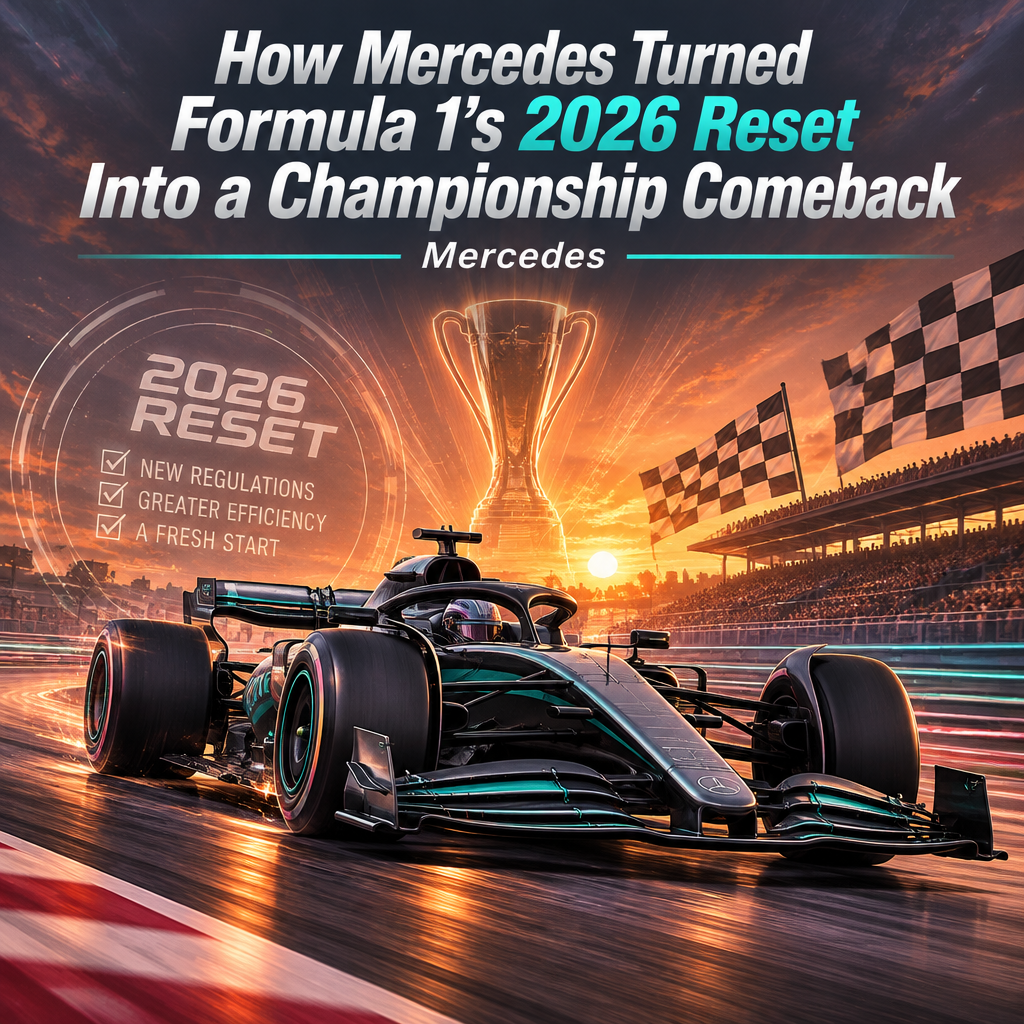
Lord described new power units that retained a 1.6-liter V-6 turbo combustion engine but increased the contribution of electrical power. He said the combined output exceeded 1,000 horsepower, with roughly half coming from the electric motor and half from the combustion engine. The new power unit arrived alongside fresh aerodynamic rules, and the chassis, electronic control unit, and tires also had to change. The FIA’s Formula One regulations repository is the primary reference for the published rule framework; the FIA has also outlined key principles for the 2026 power-unit regulations in its regulatory announcement.
That scale matters. A team can no longer rely on one clever aerodynamic detail if its energy deployment, tires, chassis balance, and race strategy fail to work together. Lord’s explanation was plain: Mercedes had done a better job with the new rule set. There is no magic in that sentence, just a great deal of difficult, coordinated work.
Why the Comeback Matters
A championship is the obvious prize. The more interesting question is what it reveals about the people and systems behind the result. In Formula 1, a new rule cycle tests whether a team can connect its departments quickly, measure the right things, and turn technical understanding into points on Sunday. Mercedes’ 2026 campaign suggests that it managed that handoff more effectively than its competitors.
The main lessons are practical:
- Integration beats isolated cleverness. The power unit, aerodynamics, chassis, control systems, tires, and fuel all affect one another. A strong component can be undermined by a weak connection elsewhere. Success belongs to the whole car and the group that develops it.
- Rule changes reward clear thinking. Lord said Formula 1 periodically changes regulations to keep performance and safety in check. In 2026, the scale of the change made the task unusually demanding: teams had to solve several connected problems at once rather than polish a familiar design.
- Driver performance still matters. Antonelli’s title and Russell’s role within the team put driver skill at the center of the result. Engineering provides the platform; the driver must interpret grip, energy use, tire behavior, and changing race conditions without confusing speed with recklessness.
- A team’s commercial value can grow with the sport. Lord said Mercedes expected to reach $1 billion in revenue for the first time. He linked the rise to Formula 1’s transformation over the prior decade from a niche interest into a much larger global sports property. Revenue is not profit, and the figure should be treated as Lord’s reported expectation, not as an audited financial statement.
- Sustainable technology requires more than a slogan. Lord noted that advanced sustainable fuel requires production infrastructure as well as a formulation suitable for racing. The environmental case depends on what is made, how it is made, and what its full supply chain involves—not merely the label on a fuel tank.
Here’s the kicker: racing’s premium appeal is not just the paddock, the lounges, or the carefully staged arrival. The craft is part of the attraction. A well-made machine can be beautiful because its form answers real demands—heat, load, speed, precision. That kind of beauty respects skilled labor, and the dignity of work deserves more attention than another glossy brand claim.
The same caution applies to the business story. Formula 1’s growth gives teams more commercial reach, but impressive revenue does not automatically mean a healthy margin or a lasting competitive advantage. For readers interested in how the series presents its broader commercial operation, Formula 1’s corporate overview offers useful context. The core point remains simple: attention can create opportunity, but a racing organization still has to deliver performance and manage its costs.
How to Evaluate a Championship Team: A Step-by-Step Guide
A trophy tells you who finished first. It does not explain why. When I assess a team’s season, I look for a chain of evidence instead of treating one headline result as proof of universal superiority.
- Start with the rule change. Identify what the championship’s new regulations actually changed. In 2026, Lord described a new power-unit balance, new aerodynamic regulations, and changes to the chassis, electronic control unit, tires, and fuel. The FIA’s regulations pages are more useful than marketing summaries when the question is what teams were required to build. A team’s job is to understand the rules as written, not the rules it wishes it had.
- Separate the car from the operating system. A quick lap is not the full product. Look at how the power unit, energy deployment, aerodynamics, tire behavior, and setup interact across different circuits. A car that works only in one narrow set of conditions may produce highlights without providing a reliable title campaign. The reported 12 wins indicate a substantial season, but they do not, by themselves, explain every technical choice behind it.
- Check performance across the season. One victory can come from an unusual race. A championship requires repeated points, sound preparation, and the ability to respond when conditions change. In this account, Mercedes’ 12 wins and the timing of the title confirmations are the reported evidence. If a detailed breakdown of poles, podiums, reliability, or retirements is not reported, do not invent one to make the story feel complete.
- Assess the drivers without reducing the team to them. Antonelli’s Drivers’ title is a central achievement, while Russell is part of the same championship operation. Drivers supply feedback and make high-stakes decisions at speed; engineers convert that feedback into adjustments and development priorities. Either side can frustrate the other. The best organizations make the exchange precise, not theatrical.
- Treat financial figures carefully. Lord said Mercedes should reach $1 billion in revenue for the first time. That is a significant claim about scale, but it is not a profit figure, a valuation, or a guarantee that every part of the operation is financially successful. Ask who is speaking, what period the number covers, and whether the amount has been independently reported or audited. Frankly, those distinctions are basic hygiene.
- Ask whether the sustainability claim has substance. Lord emphasized that developing advanced sustainable fuel involves building the infrastructure to produce it. That is a more useful starting point than assuming a fuel is environmentally beneficial because of its name. Examine sourcing, production, transport, and the rules that govern use. A credible technical ambition should withstand questions about its costs and trade-offs.
This method works beyond motorsport. It applies to luxury cars, watches, travel, and fine dining: separate evidence from image, examine the quality of execution, and ask whether the premium buys substance. A beautiful object or experience can be worth paying for, but the price alone proves nothing.
Mercedes vs. Its Biggest Historical Rivals: What the Reported Data Shows
Red Bull Racing is a natural comparison because the account describes Red Bull and McLaren as the teams that took turns leading Formula 1 during Mercedes’ more difficult four-year stretch. But the information available here does not provide Red Bull’s or McLaren’s complete 2026 results. A useful comparison should state that plainly rather than fill the gap with guesswork.
| Comparison point | Mercedes-AMG Petronas | Red Bull Racing / other rivals |
|---|
| 2026 Constructors’ Championship | Secured the title after the Brazilian Grand Prix on November 8 | Final position is not reported here |
| 2026 race wins | 12 wins reported | Win totals are not reported here |
| Drivers’ Championship | Kimi Antonelli clinched it by the Mexico City Grand Prix | Rival drivers’ final positions are not reported here |
| 2025 season, as described | Two wins; Russell fourth and Antonelli seventh in the Drivers’ standings | Detailed rival results are not reported here |
| Recent competitive context | Had a difficult four-year period after its 2014–2021 title run | Red Bull and McLaren took turns at the top during that period |
| 2026 technical challenge | Had to adapt to new power-unit and aerodynamic rules, among other changes | The same broad rule reset applied to the field; team-by-team implementation details are not reported here |
| Revenue claim | Lord said Mercedes expected to reach $1 billion in revenue | Comparable rival-team revenue is not reported here |
The table shows a decisive result, not the full mechanics of the rivalry. Mercedes’ 12 wins and two titles are strong season markers. They do not tell us exactly how many points separated the teams at each stage, how often rivals encountered reliability trouble, or whether one team held a specific pace advantage at every circuit. Those figures are not reported in the account, so a careful comparison should leave them blank.
That restraint is not pedantry. It is how readers avoid turning a sports article into brand cheerleading. Mercedes’ result is impressive on its own; it does not need an invented margin to make it sound convincing. The official Formula 1 2026 season page is a sensible place to check the championship calendar, while the team’s official Mercedes-AMG Petronas site provides the team’s own updates. Neither should be mistaken for neutral financial analysis.
Common Mistakes to Avoid
Mistake one: crediting the title to one driver alone. Antonelli’s Drivers’ Championship is a major individual achievement, but Mercedes won the Constructors’ title through a team effort. The car, engineering group, mechanics, strategists, and drivers all contribute. Reducing the whole season to one gifted young driver makes a neat headline and a poor explanation.
Mistake two: treating the new engine as the entire story. The power unit drew attention because the 2026 regulations increased the role of electric power. Yet Lord also described new aerodynamics, chassis, electronic controls, tires, and fuel requirements. These elements must operate as a system. A strong engine cannot rescue every flaw in the rest of the package.
Mistake three: confusing revenue with profit. “A billion dollars in revenue” sounds like a scoreline. It is not. Revenue describes money generated before expenses; profit depends on what remains after costs and other obligations. Lord’s statement was that Mercedes expected to reach that revenue milestone. No audited profit figure is reported here.
Mistake four: accepting sustainable language without asking how the fuel is produced. Lord’s point about infrastructure is important because it connects a product to the system needed to make it. But his comments do not, by themselves, provide a full lifecycle assessment or quantified emissions comparison. Treat them as an account of the engineering work, not proof of a particular environmental outcome.
Mistake five: assuming a win streak will last. Formula 1 is built around evolving regulations and relentless competition. Mercedes’ dominance from 2014 through 2021 did not guarantee effortless success once the ground-effect era began. The 2026 title does not guarantee the same result next season. Frankly, that uncertainty is part of the sport’s appeal.
Mistake six: mistaking premium presentation for excellence. Las Vegas can offer glamorous hospitality and a memorable setting, but a polished lounge does not establish the quality of a car, a team, or a business. The House of Robb pop-up at Resorts World gave fans a close-up conversation with Lord. The more durable story is the work that made his appearance worth hearing: technical decisions, manufacturing discipline, and a team learning to perform under new constraints.
Frequently Asked Questions
Who won the 2026 Formula 1 Constructors’ Championship?
Mercedes-AMG Petronas secured the 2026 Constructors’ Championship after the Brazilian Grand Prix on November 8, according to the reported account. Mercedes had won 12 races by that point. The account does not provide the final points margin over each rival.
Who won the 2026 Formula 1 Drivers’ Championship?
Kimi Antonelli clinched the Drivers’ Championship after earning enough points by the Mexico City Grand Prix. His title came before the Las Vegas Grand Prix, so the championship battle was already decided when the series arrived in Nevada.
Why was Mercedes stronger in 2026?
Bradley Lord, Mercedes’ deputy team principal, credited the team with adapting better than its rivals to the 2026 regulations. Those changes included a revised power unit and aerodynamics, as well as new chassis, electronic control, tire, and fuel requirements. The account does not isolate one technical feature as the sole cause of success.
What does Mercedes’ $1 billion revenue figure mean?
Lord said Mercedes expected to reach $1 billion in revenue for the first time. Revenue is the income generated by the operation before expenses; it is not the same as profit or company value. No audited financial statement or comparable figure for rival teams is reported here.
Final Thought
Mercedes’ 2026 season is compelling because its success followed a reset rather than a comfortable extension of old advantages. New rules forced the team to rethink major parts of the car and the way they worked together. Lord’s explanation gives credit to a collective achievement: engineers, mechanics, strategists, drivers, suppliers, and the people building the infrastructure behind a new fuel specification.
There is a luxury lesson here, though not the one that usually appears in a glossy advertisement. Quality is rarely a single expensive material or a prestigious name. It is the discipline to make parts work together, the patience to test a design, and the skill of people whose work is often invisible when the finished product takes the spotlight. That is true of a race car, a hand-finished watch, a well-run hotel, or a dining room that makes difficult service look effortless.
The commercial expansion Lord described can help Formula 1 reach new audiences and fund ambitious work. It also makes clear thinking more necessary, not less. Revenue is not profit; a sustainability claim deserves evidence; a championship does not make every decision flawless. Beauty and excellence can be appreciated without abandoning discernment. Mercedes earned the headlines in 2026. The more valuable question is whether the habits that earned them—craft, coordination, and honest measurement—last beyond one successful season.